

Insiders Events
After-Hours Tour of "Noguchi's New York" Exhibit
Join an exclusive curator-led tour at NYC's Noguchi Museum!
Join an exclusive curator-led tour at NYC's Noguchi Museum!

Munch on snacks from local vendors while learning about the history of street food!
Uncover stories of NYC ghosts from A Haunted History of Invisible Women!

Discover which NYC buildings—both lost and extant—have been recreated out of plants!


There's nothing on the planet quite like the New York Botanical Garden's Holiday Train Show, which replicates our city's most treasured buildings, recreating them as botanical masterpieces. Limestone, marble, iron, wood, glass, and steel are replaced with evergreens, twigs, hollies, moss, pine cones, bark, and tree roots. Among and between the nearly 200 buildings, trains chug and glide on 1,200 feet of track, reminding us that New York was once a great train city. And now, in the Bronx, it is once again.
The original genius who created the first train show in 1992—and who invented the term "botanical architecture"—is landscape architect Paul Busse. One of his designers, sculptor Annette Skinner, says that her boss "has a unique concept that requires integration of the natural world with traditional G-scale model railroad layouts." Founder of the firm Applied Imagination, Busse is a train buff as well as a lover of the forests around his headquarters in Alexandria, Kentucky, 14 miles down the Ohio River from Cincinnati. Those forests provide much of the material to fabricate New York's skyscrapers and mansions.
Busse's first building for NYBG was what his daughter, Laura Busse Dolan, calls a "sample:" Poe Cottage. The original cottage, built in 1812, is situated a few blocks away from the Botanical Garden in the Bronx. There Edgar Allan Poe wrote "The Bells," inspired by the church bells ringing at neighboring Fordham University's bell tower, and "Annabel Lee," one of his greatest poems.

Poe Cottage is far plainer than the magnificent building that Busse replicated next: St. Patrick's Cathedral in Manhattan. Busse's botanical St. Pat's looks remarkably like the real one standing majestically on Fifth Avenue. Designed by James Renwick, Jr., one of the nineteenth century's finest architects, St. Patrick’s is the largest Neo-Gothic Roman Catholic cathedral in the country. Dolan, who now heads Applied Imagination, says she isn't sure why her father chose St. Patrick's as his first major botanical building. But she notes that one huge plus in addition to its fame is its sumptuously decorated facade.
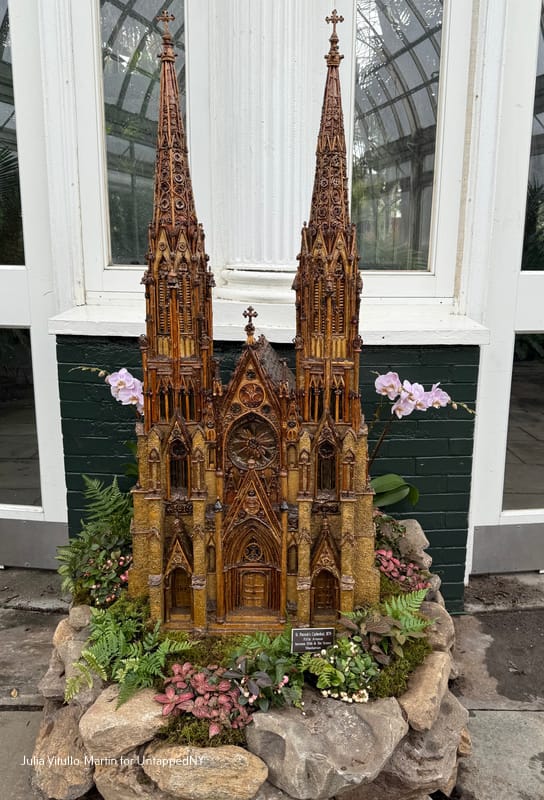
The botanical model of St. Pat's required three artists working hundreds of hours to complete, using 60 different plant parts overall. Its rose window is composed of eucalyptus pods, pine cone scales, grapevine, poppy seeds, and Siberian iris seed pods.
The Train Show offers two extraordinary train headquarters: the tragically demolished Penn Station and the still-standing, formidable Grand Central Terminal.
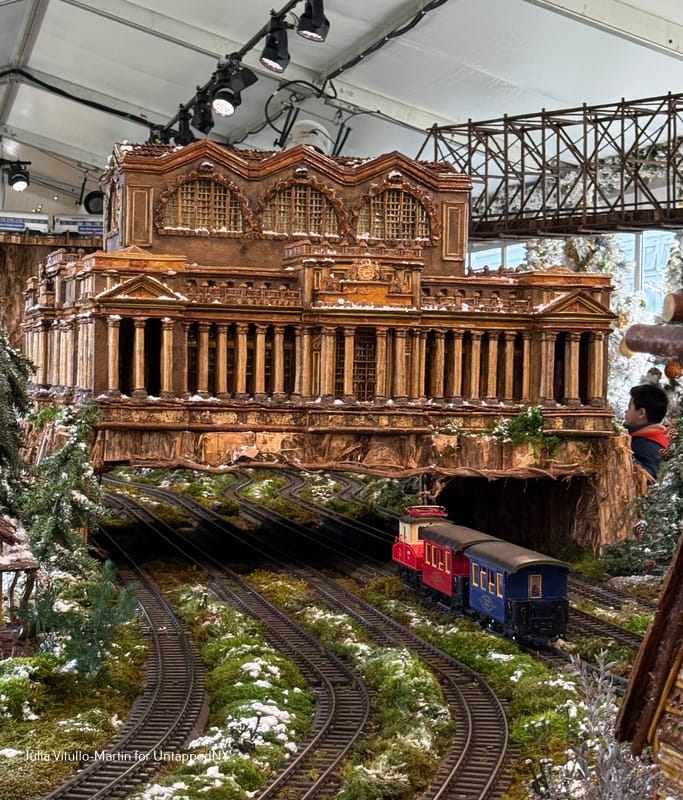
Penn Station's botanical building materials, according to NYBG, include "columns made of honeysuckle, façade trim of sea grape leaves, peppercorns, viburnum, willow, and oak bark, and railings of screw pod, burning bush, willow, and acorn caps. The roof is magnolia, and pine cone scales, and the sky lights are burning bush and basket reed. The adorning eagles have white pine cone bodies, hemlock clove feet, magnolia bud feathers, and acorn cap wings. The clocks are birch bark and wheat seeds, and the statues have pistachio bodies and cedrela wings."
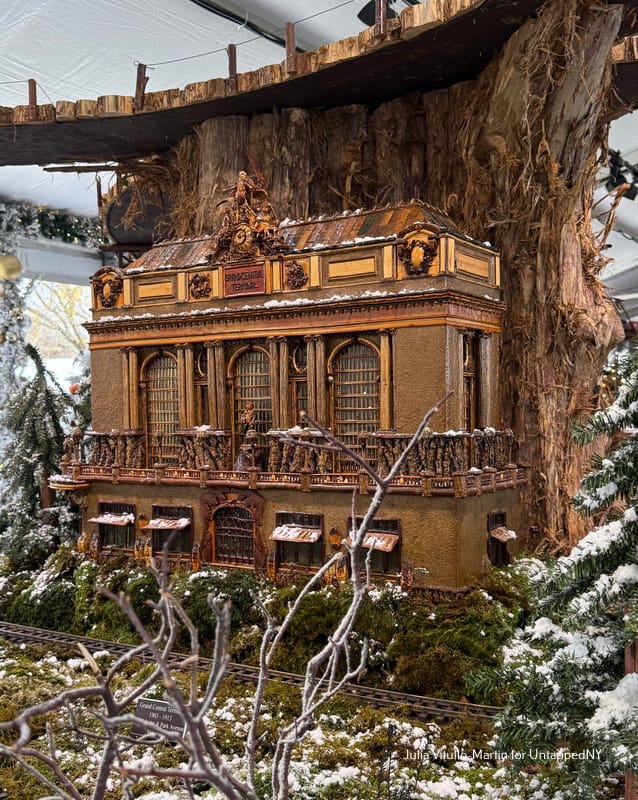
Similarly, the replica of Grand Central has columns of sticks, stone walls mimicking limestone, huge rounded windows, and three detailed statues of Hercules, Mercury, and Minerva, representing strength, commerce, and wisdom.
The five boroughs house 83 museums, with the heaviest concentration on a one-mile stretch of Fifth Avenue on Manhattan's East Side. The Metropolitan Museum stands at 80th Street, hugging Central Park, from which it has taken substantial property over the years. The NYBG points out that the replica uses cinnamon curls to recall the Met's Ionic columns.
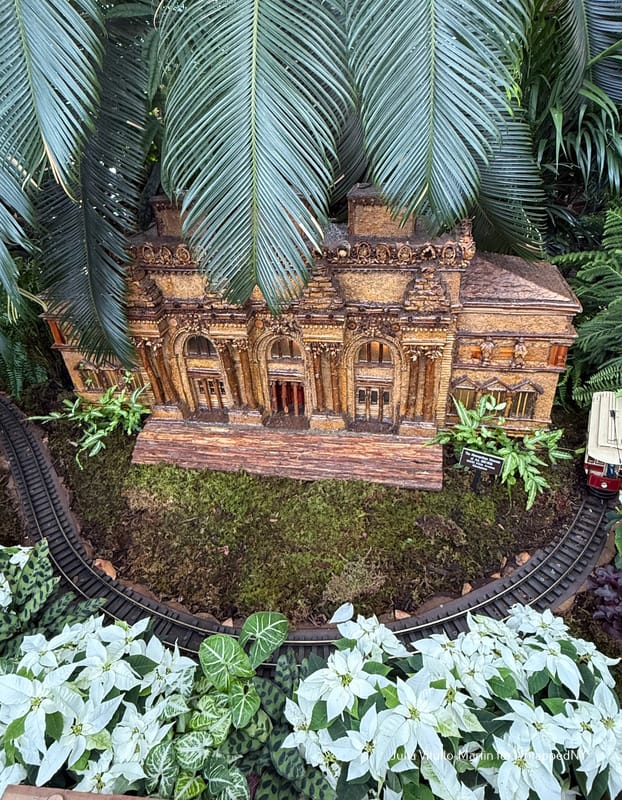
Above the Met at the Train Show are six classic row houses, which Dolan says are among her favorite replicas.
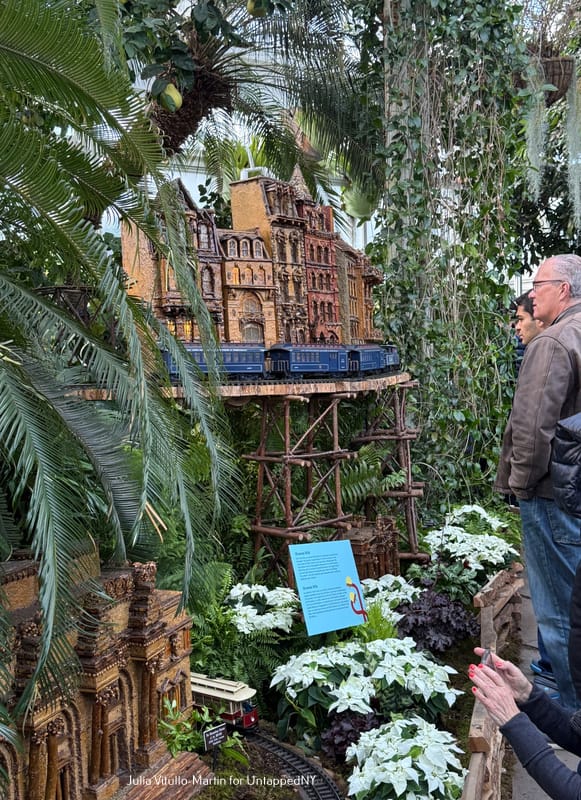
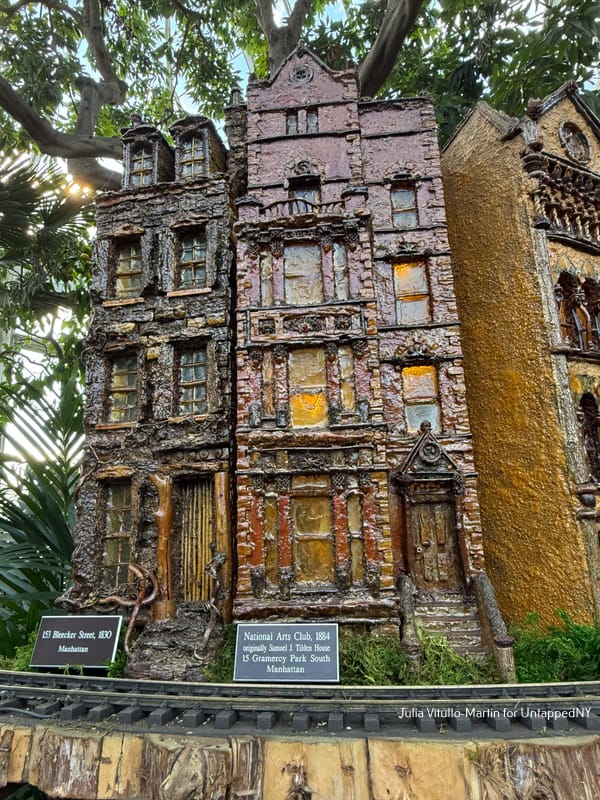
(Left) Classic New York row houses, some demolished (Right) The elegant National Arts Club is located at 15 Gramercy Park South.
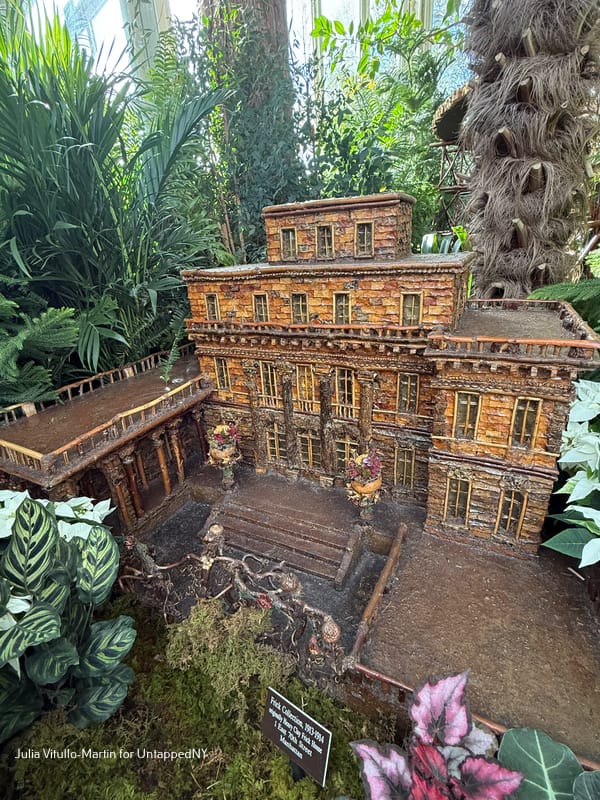
The Frick Collection, a favorite with New Yorkers and especially European tourists, stands ten blocks away from the Met at Fifth Avenue and 70th Street. “The Met is admired, but the Frick is beloved,” says architecture critic Paul Goldberger, comparing New York City’s largest and wealthiest museum with its reserved Fifth Avenue neighbor, which recently reopened after years of renovation.
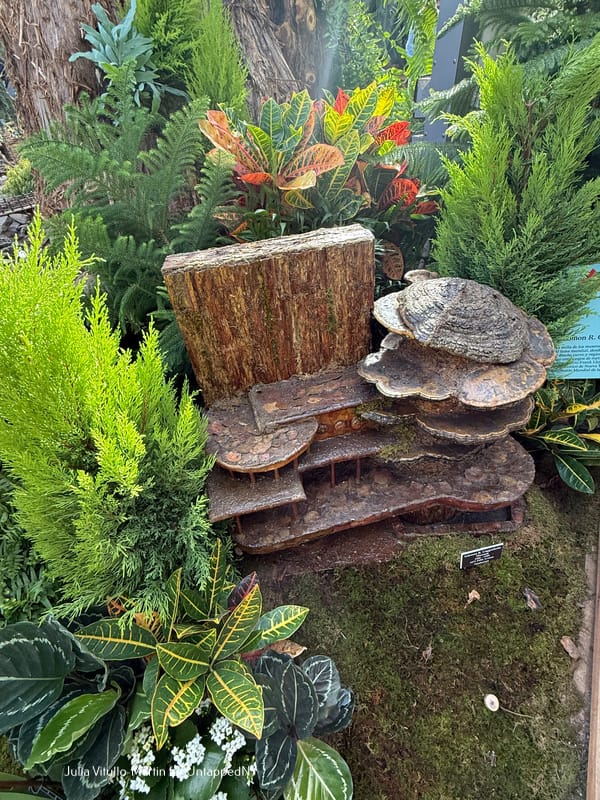
"Are those mushrooms, daddy?" asked the little boy to my left. Yes, indeed, the Guggenheim has been recreated with shelf fungus. "I think Frank Lloyd Wright would approve," says Dolan, referring to the Guggenheim's famously irascible architect. The Guggenheim is both a New York City landmark and a UNESCO World Heritage Site.
The Cooper Union for the Advancement of Science and Art, a private college founded by Peter Cooper in 1859, was tuition-free for most of its history. Its alumnae include renowned architects, engineers, and artists, such as Augustus Saint-Gaudens, Milton Glaser, Lee Krasner, and Thomas Edison. Appropriately enough for the train show, Cooper was an industrialist who designed and built the first American steam locomotive.
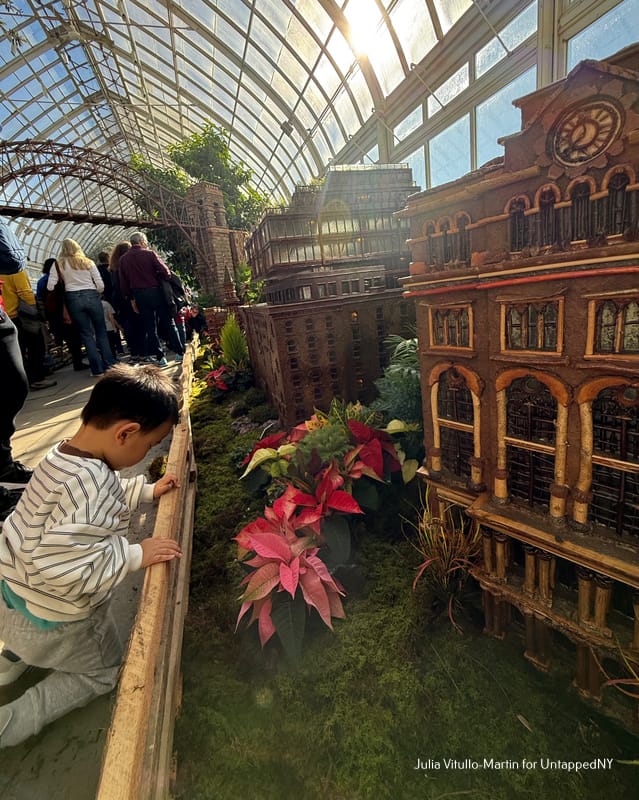
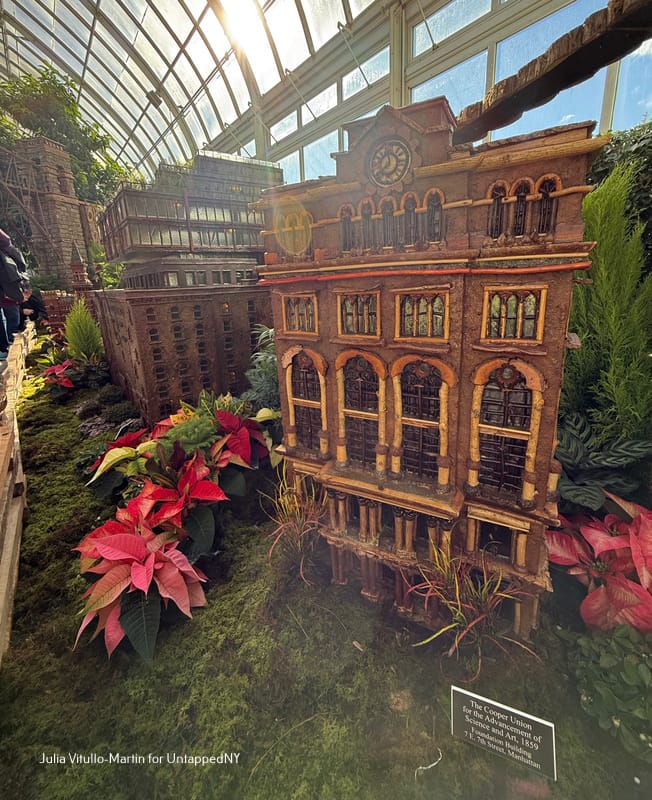
Cooper Union for the Advancement of Science and Art, 1859
Without Central Park, densely populated Manhattan would be a very different and far less civilized place. And without the Delacorte Theatre, opened in 1962 on the edge of the Great Lawn, Central Park would still be great, but less glamorous and exciting. Closed for a substantial renovation between 2023 and 2025, the Delacorte was reopened this summer to present a spectacular Twelfth Night hosted by The Public Theater's Shakespeare in the Park. The Holiday Train Show honors the re-opening by giving the Delacorte and Central Park a large circular platform, with an NYBG train winding through the familiar landmarks of Bethesda Terrace, the Bandshell, Belvedere Castle, Bow Bridge, and the Dairy.
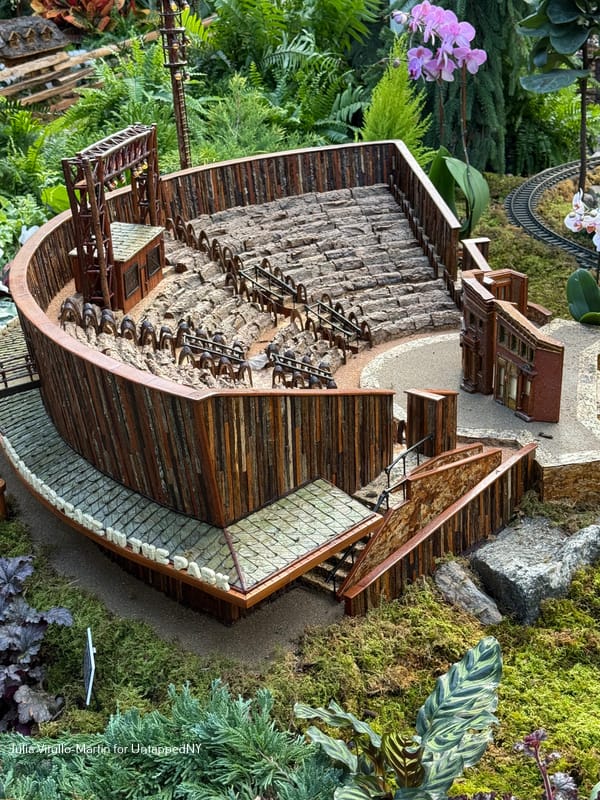
Sitting in the real-life Delacorte, waiting for Shakespeare to begin, one can easily spot Belvedere Castle. Constructed of Manhattan schist in 1872 on a huge outcropping, it is the second-highest natural point in Central Park.
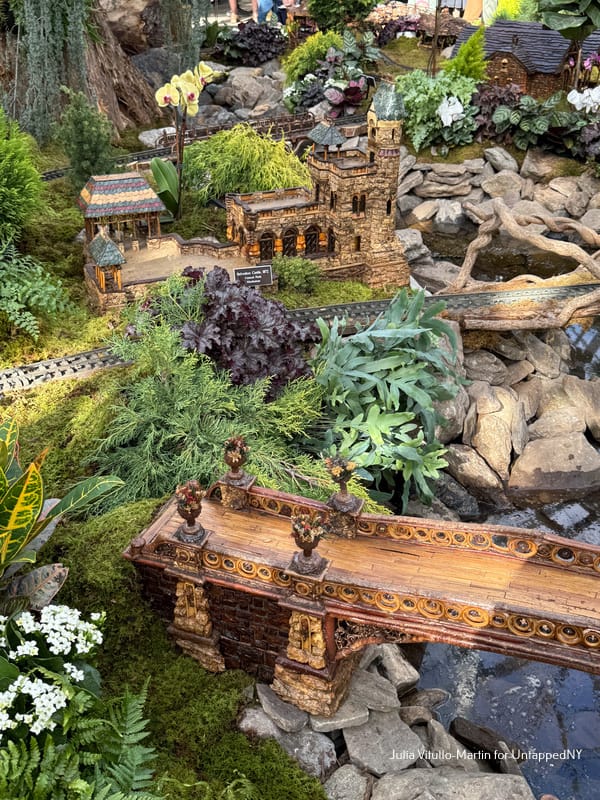
Bethesda Terrace, world-renowned for its elegance, is a familiar sight because it has appeared in so many movies. In his terrifying journey through Central Park in 1976's Marathon Man, Dustin Hoffman stops briefly for a moment of peace beside the Angel of Waters. Bethesda Terrace has also starred in The Avengers, One Fine Day, Home Alone 2, Elf, and Enchanted.
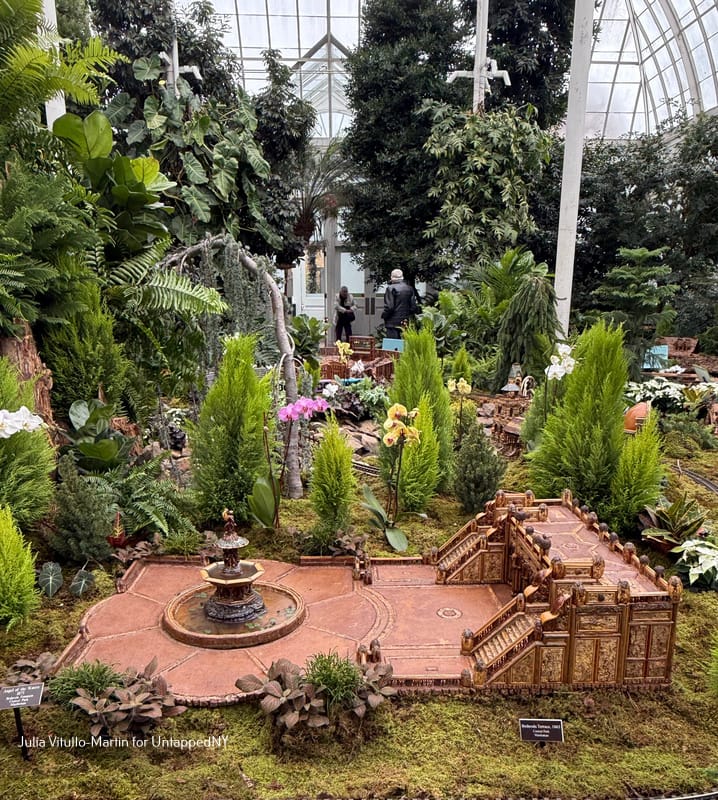
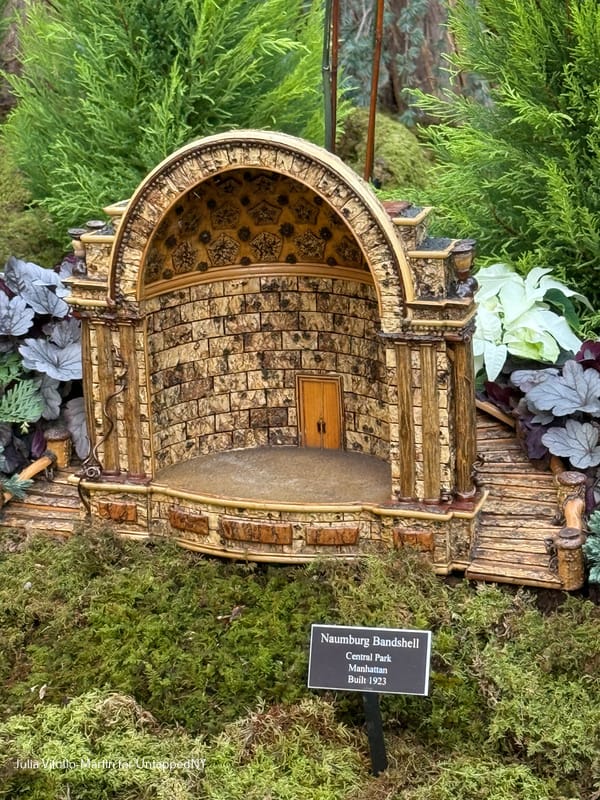
Built in 1923, the Naumburg Bandshell replaced the far more ornate, and possibly more loved, Mould Bandstand, built in 1862 as a Moorish pagoda. Naumburg has hosted many musical stars, including Irving Berlin, John Phillip Sousa, Duke Ellington, and The Grateful Dead. As the only neoclassical building in Victorian Central Park Naumburg has periodically been proposed for demolition, even by the Central Park Conservancy itself.
While the Train Show is a love letter to New York as it stands today, it also reminds us of how much we've lost. Penn Station, of course. Opened in 1910 and destroyed fifty-three years later, its horrific demolition led to the creation of the Landmarks Preservation Commission, charged with protecting the city's "architecturally, historically, and culturally significant buildings and sites by granting them landmark or historic district status, and regulating them after designation."
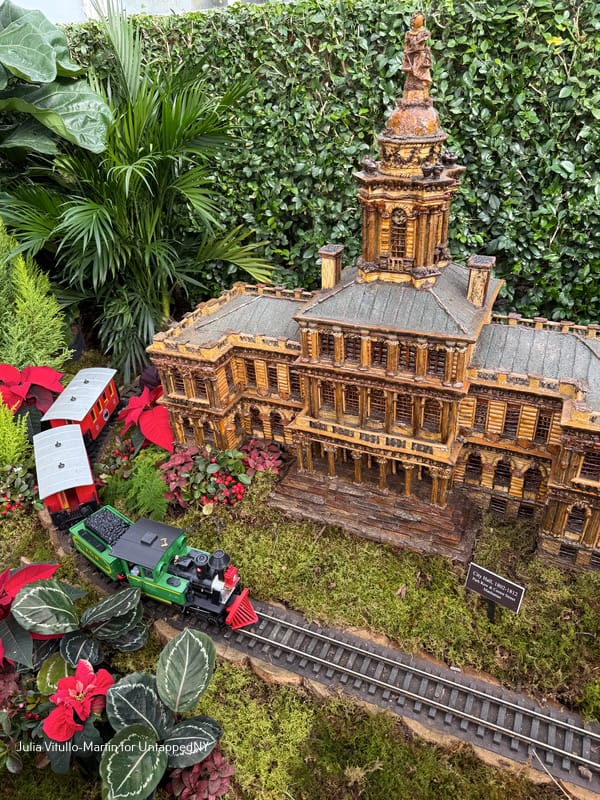
Let's start with a beloved building that has endured: Despite multiple demolition threats, most recently in 1974, City Hall has fought off enemies and endured since 1811. (Amazingly, the New York Times supported a proposal for demolition in 1893.) The Landmarks Preservation Commission designated City Hall's exterior in 1966 and its interior in 1976.
Hundreds of New York's brownstones, row houses, and townhouses have been demolished, but with the help of the Landmarks Commissio,n the city is holding onto the many that remain.
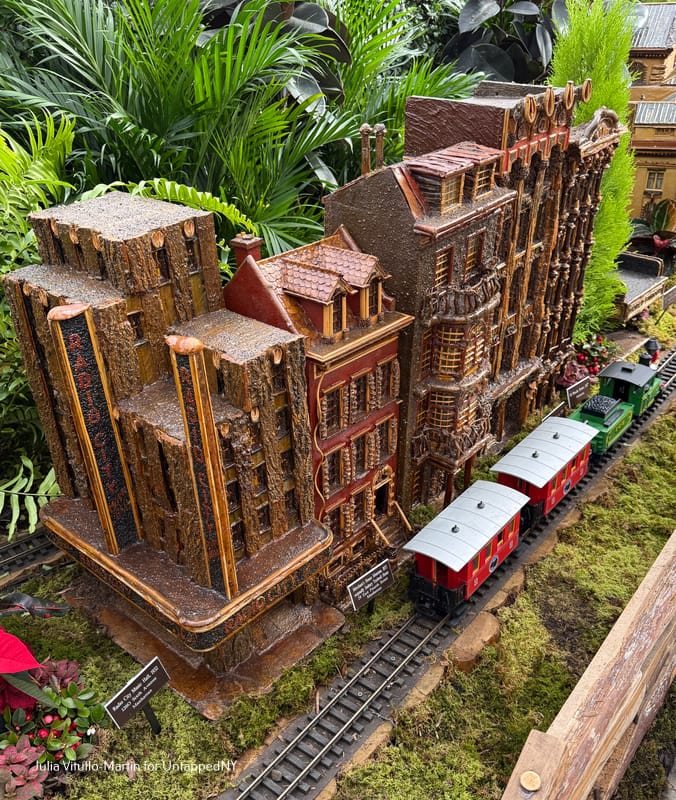
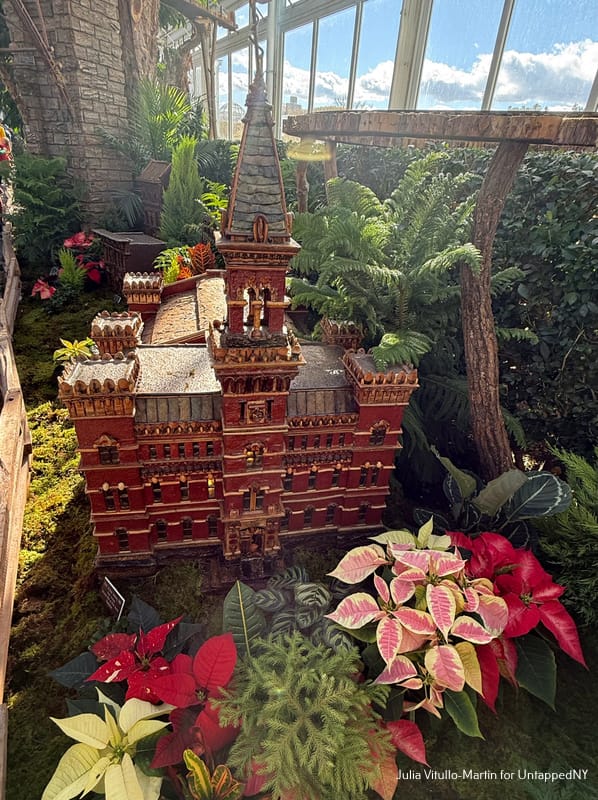
Other beautiful buildings, like the Gothic Revival Park Avenue Armory, have endured but lost some lovely part of themselves. The Armory's bell tower stands proudly tall in the Train Show, but it was removed in 1909 in order to add two floors to the building to make it look like more of a fortress than a castle. Now the Park Avenue Armory Conservancy watches over the Armory, reimaging the space as a center for the visual and performance arts.
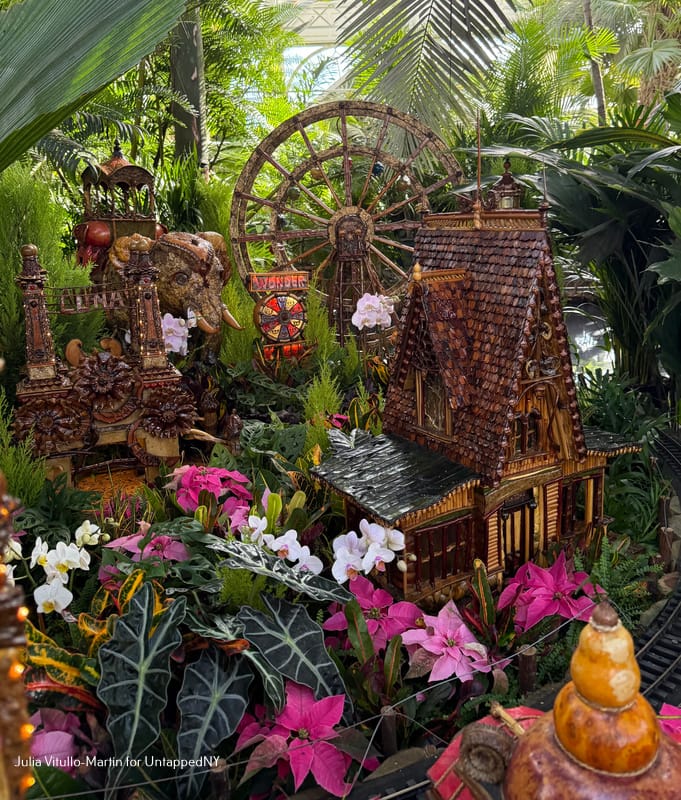
Brooklyn's Coney Island seems mythical, but it was and is real. Many original attractions have been destroyed, including the 200-foot-tall Elephantine Colossus that had held a concert hall and a hotel with 31 rooms. The Wonder Wheel remains.
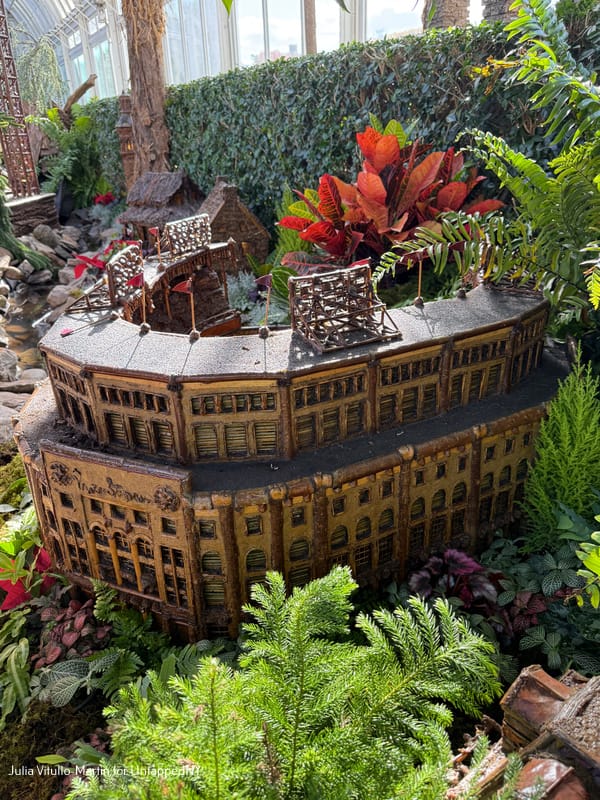
The original Yankee Stadium was demolished in 2010. Its site became a public park named, apparently without irony, "Heritage Field."
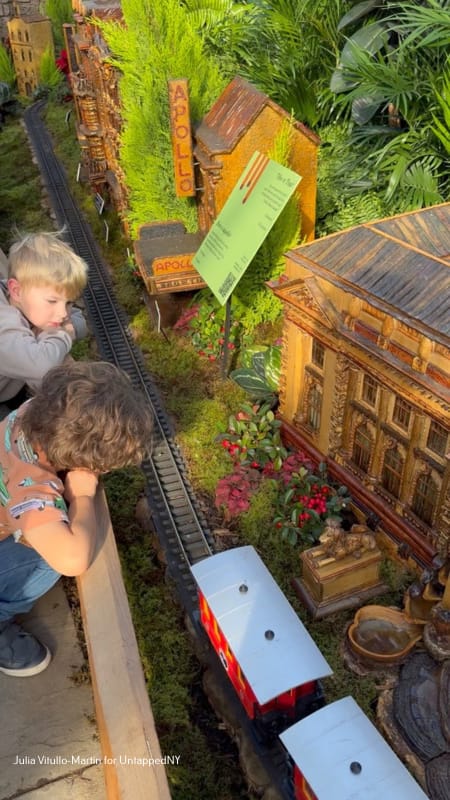
Located in the Bronx at 2900 Southern Boulevard, NYBG hosts the Holiday Train Show through January 11, 2026.
Hours: The Garden is open 10 a.m. to 6 p.m., Tuesday through Sunday, and on some Monday holidays.
Pricing varies. See info and book online here!
Subscribe to our newsletter