


MoMA PS1 Celebrates Its 50th Anniversary Promoting Emerging Art
This art museum's latest exhibit celebrates a milestone anniversary and the burgeoning local artists of NYC!

New York City’s art world of the 1970s is having a moment—which is amazing, given that New York was on its knees in the 1970s. The city narrowly escaped being forced to declare bankruptcy in 1975, violent crime soared, garbage mounted in the streets, and the economy stagnated. Homicides jumped from 1,117 murders in 1970 to 1,812 in 1979 (contrasting with 305 homicides last year). The federal government wiped its hands of New York. President Ford's refusal to help inspired the notorious Daily News headline: “Ford to City: Drop Dead.” A population exodus of elites topped off the misery. And yet the 1970s was an era of brilliance for New York artists, sculptors, and photographers—as recent museum shows celebrating 20th century artists have reminded us.
The Museum of the City of New York mounted an exhibit of photographs taken by Robert Rauschenberg of New York friends before he became a famous artist. Giants such as Jasper Johns, Merce Cunningham, Cy Twombly, John Cage, and Trisha Brown appear, young and eager. Renowned sculptor Isamu Noguchi left Greenwich Village to open a museum in his own name in a bleak neighborhood in Queens in 1961. Ten years later, in 1971, Alanna Heiss founded what would become MoMA PS1.
After staging what MoMA called "roving exhibitions in empty spaces throughout New York," Heiss secured a lease from the city to move her operation into an 1892 Romanesque-revival abandoned school, PS1, in Long Island City, Queens, not far from Noguchi's Museum. The PS1 Contemporary Art Center was born.
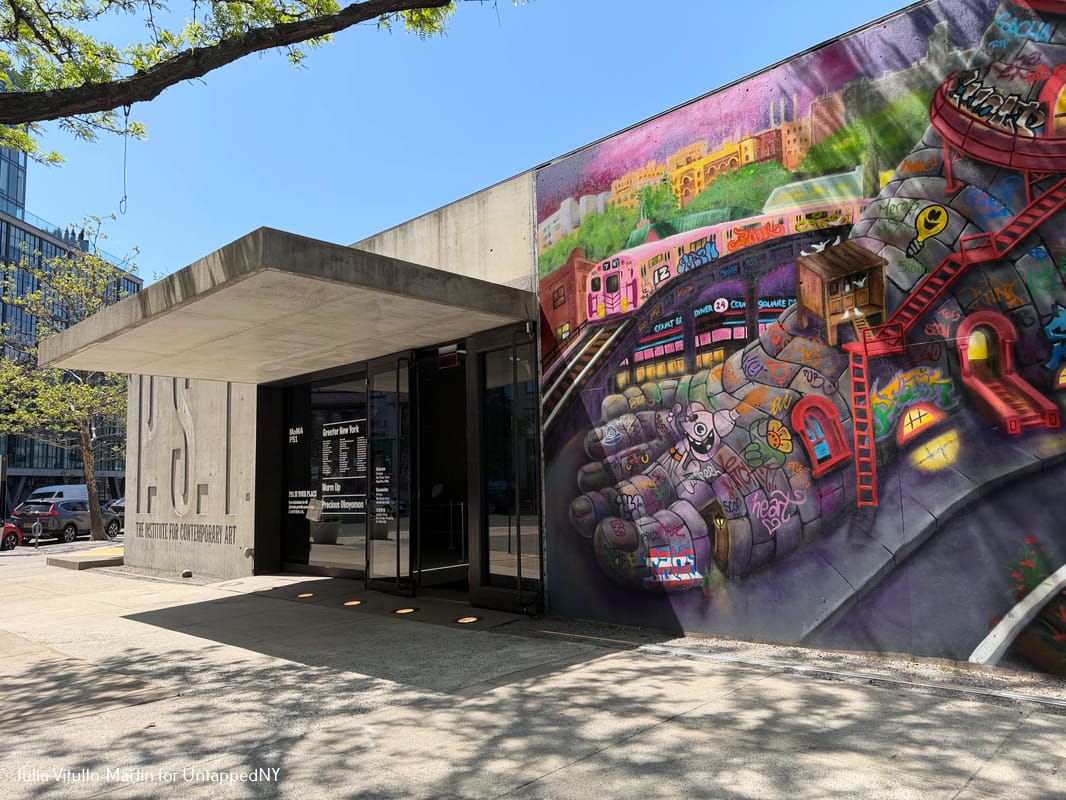
In an intriguing publication called MoMA PS1: a history, MoMA curator Klaus Biesenbach tells Heiss she located PS1 in "the most boring neighborhood" in New York. Heiss responds, "It was in the best possible neighborhood. I loved the location. In the boroughs, you always had to know where Manhattan was. You came out of PS1 and you could see the sky and Manhattan. And PS1 had the best transportation of any place in town. It had so many things in its favor." She, along with Noguchi, turned out to be right and Biesenbach turned out to be wrong.
As Leslie Wayne in The New York Times noted recently, "PS1 was part of a wave of alternative art spaces started in the 1970s to showcase unknown artists and offbeat works. Many of its peers are also entering middle age. PS1, however, stands out. It is the largest, by far. It is (unusually) still in its original location. And, its tie with MoMA gives it a unique, sustainable business model."
Greater New York
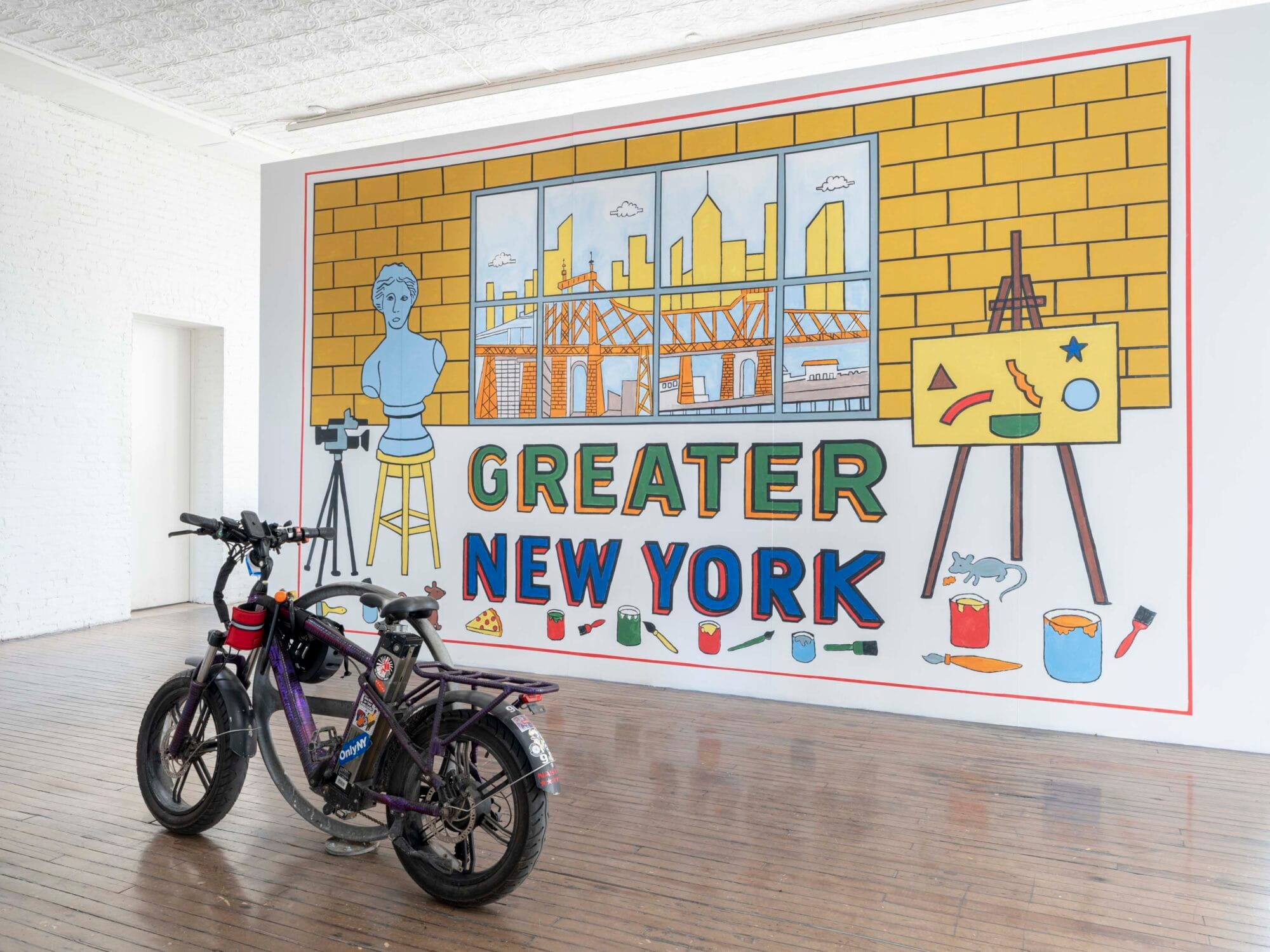
Founded originally as an anti-museum, PS 1 joined the most established of the New York establishment when it merged with MoMA in 1999. In 2000, MoMA PS1 announced Greater New York, a quinquennial survey of New York-based artists committed to producing local, emerging, and innovative work. And it's probably fair to say that many of the artists are also committed to producing work that would never be shown at MoMA on 53rd Street.
Greater New York's original, aggressive tagline was: “New Art in New York Now.”
The 2026 show has no overarching theme beyond "the forces that shape daily life in the city today, as well as strategies of resistance and adaptation in the face of increased surveillance, economic precarity, and shifting technologies," says the program.
Local and Lovable
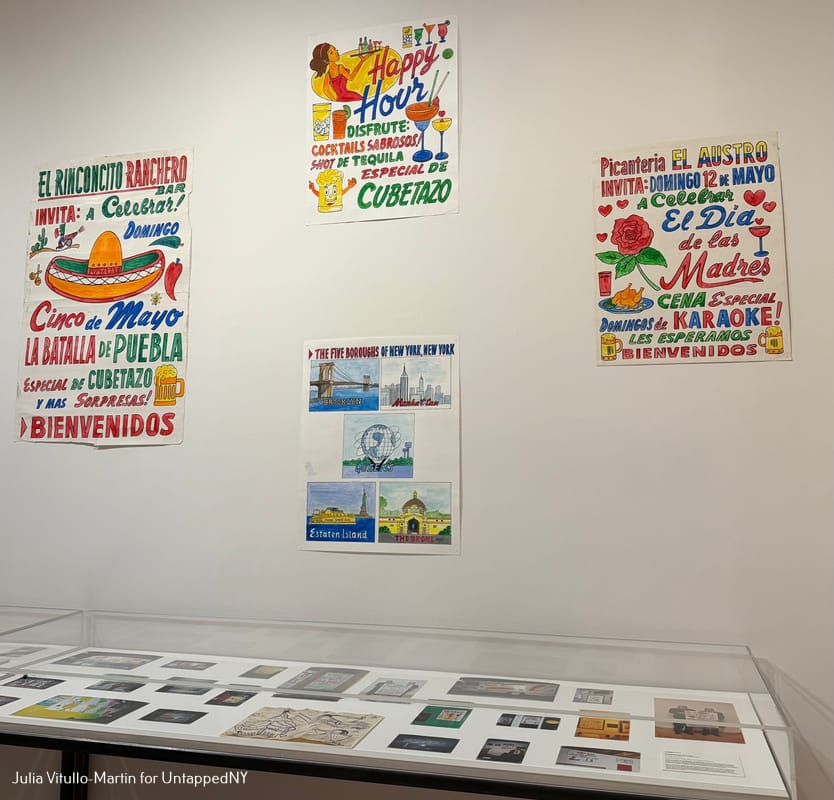
Nearly every visitor stops to admire and ponder the work of the Cevallos Brothers who for fifty years (another anniversary) have produced hand-painted carteleras (posters) for businesses in Queens. "Their paintings show you the skyline of the 7 train," says curatorial assistant Sheldon Gooch, especially those on Roosevelt Avenue in Jackson Heights. Their work serves as a record of Latin American social life in New York, says the caption, "their colorful signage both promoting goods and contributing to visual culture." For the Ecuadorian-born Cevallos Brothers, the five boroughs include "E Staten Island."
Long before their recognition by MoMAPS1, the Cevallos Brothers were honored by food critics. "Their handiwork is charming for its cheeky details, nostalgic lettering, and general lack of interest in perfection," says Eater. According to Nick Padilla, co-owner and chef of buzzy El Pingüino,“There’s a really great childlike quality to their work, and I love that it’s kind of a local thing to have one in your place.”
You can find their work on Instagram, which has helped the Cevallos Brothers expand their market into the hip businesses of downtown Manhattan.
Local to Global
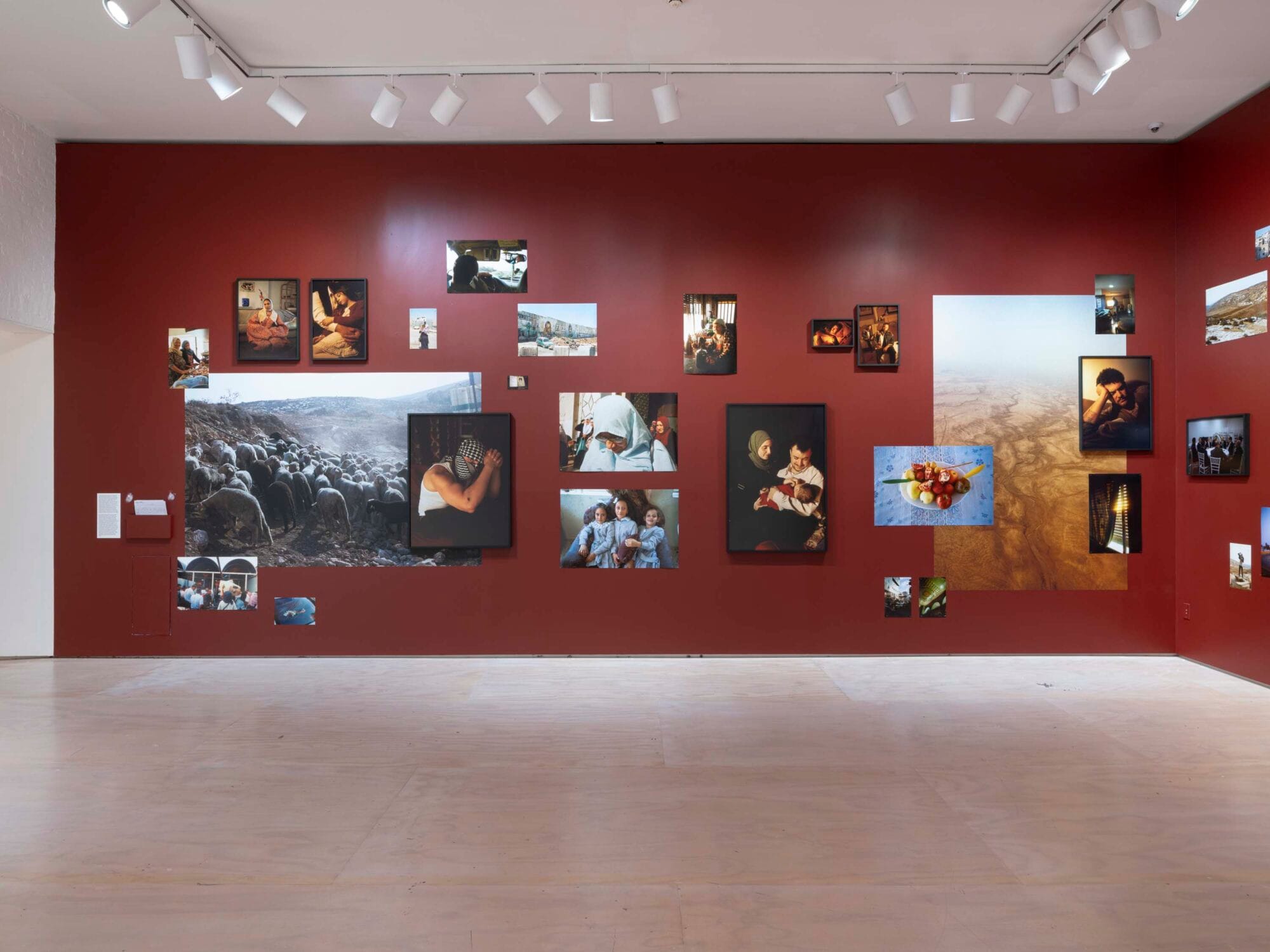
MoMA PS1's caption says that "this installation brings together two series by Dean Majd, photographs of Palestinian life in the West Bank and in New York City." Raised in Queens, where he was born in 1990, Majd in Birthmark photographs the Palestinian diasporic community of his generation, mainly artists, creatives, cultural producers, and activists living in New York. In Separation, he photographs relatives in the West Bank. "Across both series," says the caption, "Majd depicts a network of relations and demonstrates how private everyday moments are inseparable from the political." The juxtaposition of a herd of sheep and a grove of olive trees with Palestinians living in Brooklyn, far from home, is sobering.
Majd says that the installation offers "a Baroque vision of Palestinian life, a visual society."
Local and Angry
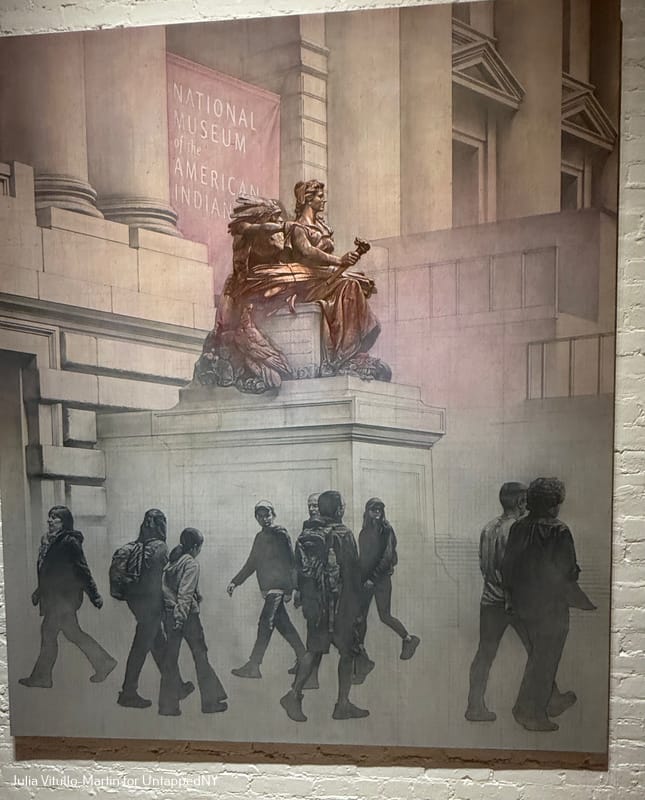
In the same gallery and facing Majd's photos, are the paintings of Esteban Jefferson, born in 1989 in New York. Jefferson and Majd are friends, said Sheldon Gooch, although MoMA PS1 didn't realize it when they hung their art in the same gallery. But it makes sense, says Gooch, since Jefferson is concerned with the "colonial legacies that loom over us."
Daniel Chester French's monumental marble sculptures, "Four Continents," are as magnificent today as they were when they were installed outside the U.S. Custom House in downtown New York in the early 20th century. But today they give us pause. The sculpture above, "America," is an assertion of American exceptionalism and superiority, seating America on a throne, her right foot on the head of Quetzelcoatl, the Mesoamerican plumed serpent. At her right shoulder is an American Indian in head dress. On her knee are sheaves of corn, symbolizing, said French, "the American idea of Plenty." Together, the four continents symbolize the global reach of the Port of New York, says MoMA PS1. The actual carving by the way was done by the Piccirilli Brothers, who carved so many monuments in New York, including those at the Frick Collection.
And below the monuments, in Jefferson's paintings, walk ordinary people of different races and genders. "By rendering select figures in oil while leaving others in graphite," says MoMA PS1, "Jefferson shifts emphasis between the monuments and their overlooked context."
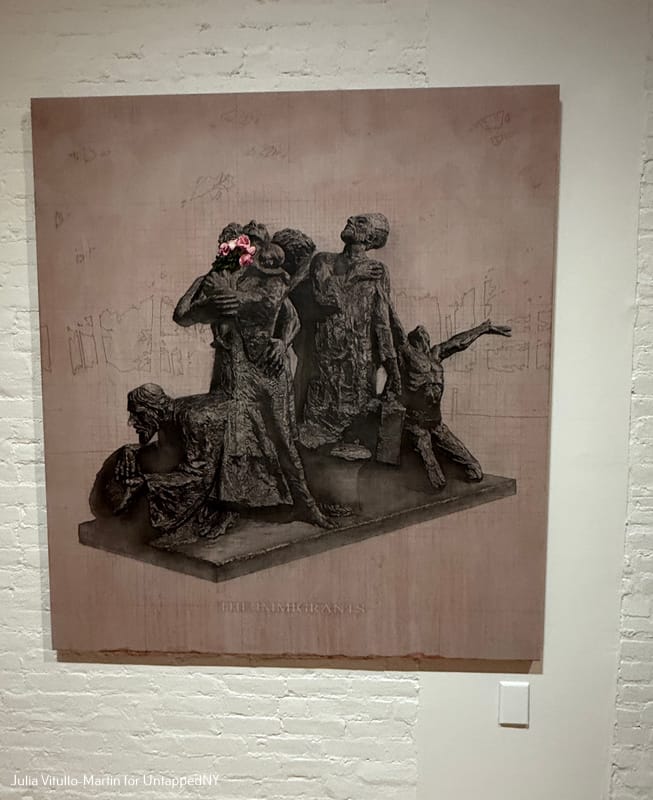
More agonizing is Jefferson's "Immigrants," a painting on linen of Luis Sanguino’s 1983 public sculpture showing immigrants arriving at Ellis Island. The main focal point, says Jefferson, is the child held in a mother's arms. When he passed the sculpture in Battery Park two years ago he saw that someone had laid a bouquet of flowers on the child's back. He photographed this for his painting.
Local and Hip
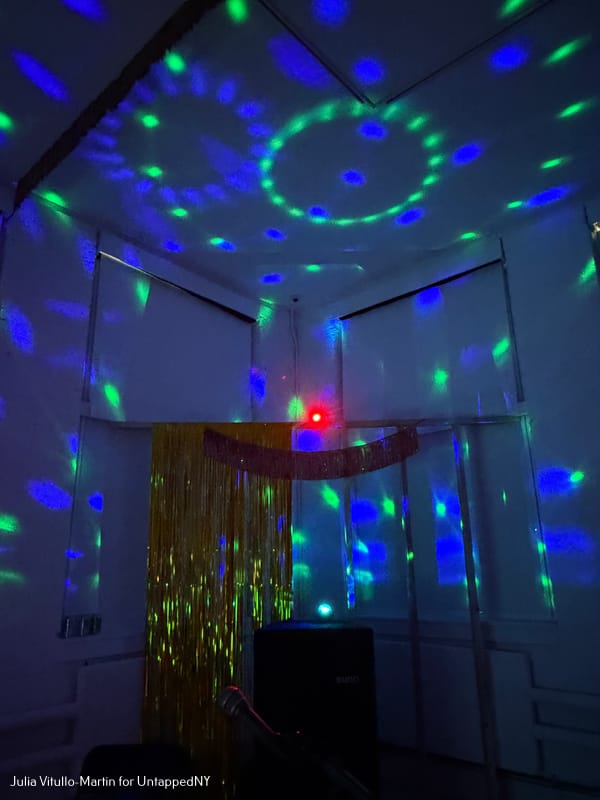
Born in Los Angeles in 1987, Mekko Harjo now lives and works in Brooklyn. As an installation and sound artist, Harjo ponders the heterogeneity of urban indigenous experiences in the US, and interfaces those experiences with night. Some 70 percent of indigenous Americans live in cities, according to the US Census. Harjo believes that nightlife spaces might act as generative arenas for indigenous collectivity and thought. His multimedia presentation of the nightclub, "I have eaten and made friends" builds on the story of the "Devouring Hill," where a trickster rabbit lures human beings in with the promise of food and warmth, only to devour them. The young hipster standing beside me commented, "I guess that's what New York does, right? It invites us in and devours us, our work and our youth."
The Past and Future of New York's Art World
The theme of New York devouring the young and the beautiful is of course an old one, as is the theme of New York as hellhole, along with New York as paradise. As New York Magazine art critic Jerry Saltz recently reminisced about the 1980s, "For a while, I lived with my wife, Roberta Smith, also an art critic, in a tiny fifth-floor rear studio on Avenue B that I bought for $5,000 from a lawyer who didn’t actually own the building. We never paid rent there. I remember dogs patrolled the hallway, we were robbed constantly, drug dealers lived downstairs. I was in heaven. It was the greatest period of my life."
And yes, something important has been lost since the bad old days, when somehow, at least in the art world, giants walked the earth of Manhattan. In an essay that's gone viral in October magazine, "New York Real Estate and the Ruin of American Art," critic Josh Kline blames "the staggering prices and rents for commercial and residential real estate in New York City today... that smother art in a choking, conservative atmosphere."
Still, artists continue flocking to New York, doubling or quadrupling up as necessary, taking multiple jobs, and producing their art. In five years, with a seventh Greater New York, we'll find out whether we've escaped ruination.
MoMA PS1’s “Greater New York” survey is on view through August 17 at MoMA PS1, 22-25 Jackson Avenue, Long Island City. Admission is free.
