


An Art Guide to Penn Station in NYC
Uncover original signs and architecture dating back almost a century, alongside innovative new art installations!

Though many New Yorkers probably consider Grand Central Terminal the artsiest transportation center in New York City, Penn Station certainly puts up a good fight. Parts of Penn Station’s original gorgeous Beaux-Arts structure, which was demolished in the mid-1960s, are buried under the new building that New Yorkers know today. Although Amtrak only officially acknowledges one existing remnant, there are indeed over a dozen remnants of the McKim, Mead & White building hiding in plain sight. With the addition of Moynihan Train Hall and the public art initiative Art at Amtrak, there are now also about half a dozen art installations scattered throughout the station.

Secrets of Penn Station & Moynihan Train Hall Tour
Discover hidden remnants of old Penn Station and explore a new train hall inside a historic Post Office building!
Penn Station’s Half Century by Stan Douglas
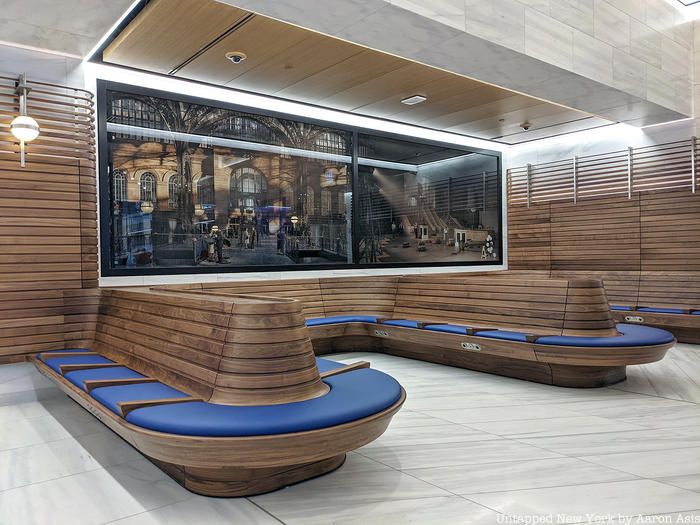
Stan Douglas conducted archival research to recreate nine moments from the old Penn Station in his installation “Penn Station’s Half Century.” To capture this history, he cast 400 actors to dress in period costumes over four days — 100 on each day of shooting — then used digitally recreated interiors of the demolished building as a backdrop. His panels include scenes of Black vaudeville performers performing after a 1914 snowstorm, outlaw Celia Cooney posing, and Penn Station as the soundstage for Vincente Minnelli’s 1945 film “The Clock,” starring Judy Garland.
These moments hang along the station’s 80-foot-long waiting area. The models for the installation were all captured at the beginning of the pandemic, with everyone photographed individually and images layered atop one another. The Canadian artist has explored themes of jazz and blues, modernism, cinema, and Samuel Beckett in his artworks.
Art at Amtrak at Penn Station
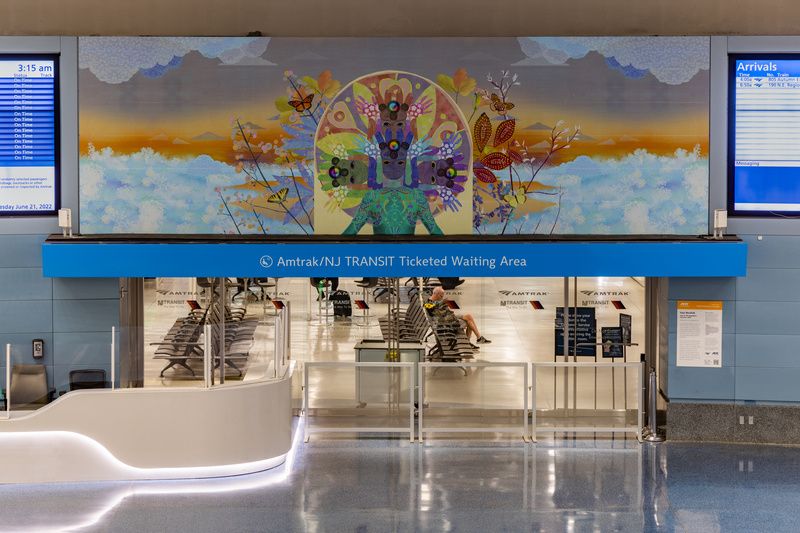
Art at Amtrak is a year-round public art initiative that uses visual works to enliven one of the city’s most important transit hubs. Art at Amtrak specifically showcases the work of New York and New Jersey-based artists. The installation launched in June 2022 with Saya Woolfalk‘s The Emphatics, in the rotunda of the Amtrak area of Penn Station. In 2023, the program expanded into Moynihan Train Hall where art can be found on digital screens. The series is curated and produced by Debra Simon Art Consulting.
Go by Kehinde Wiley
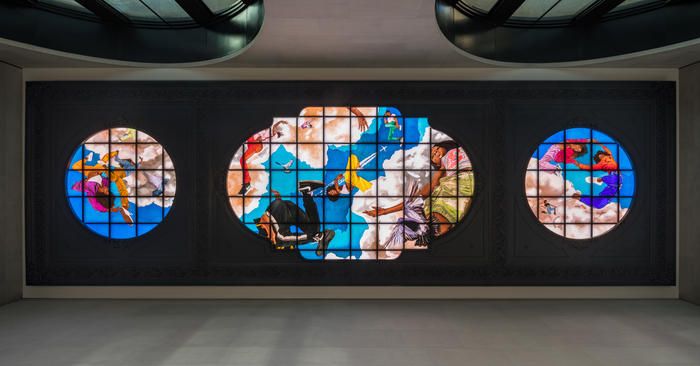
Kehinde Wiley created a hand-painted glass triptych titled Go for the ceiling at the West 33rd Street entrance to Penn Station. The work, which was Wiley’s first permanent site-specific installation in glass, depicts Black New Yorkers who look as though they are breakdancing against a blue sky. Wiley also included a woman pointing her finger similar to Michelangelo’s Creation of Adam at the Sistine Chapel. He drew from foreshortening techniques, which involve producing a dimensional illusion, to depict individuals wearing their regular streetwear with gravity-defying abilities.
Wiley wished to “play with the language of ceiling frescoes” because in ceiling frescoes, “people [express] a type of levity and religious devotion and ascendancy.” Wiley is best-known for works like Napoleon Leading the Army over the Alps, which is in the Brooklyn Museum, and the official portrait of President Barack Obama, from the National Portrait Gallery which was on view at the Brooklyn Museum last year.
The Hive by Emgreen & Dragset
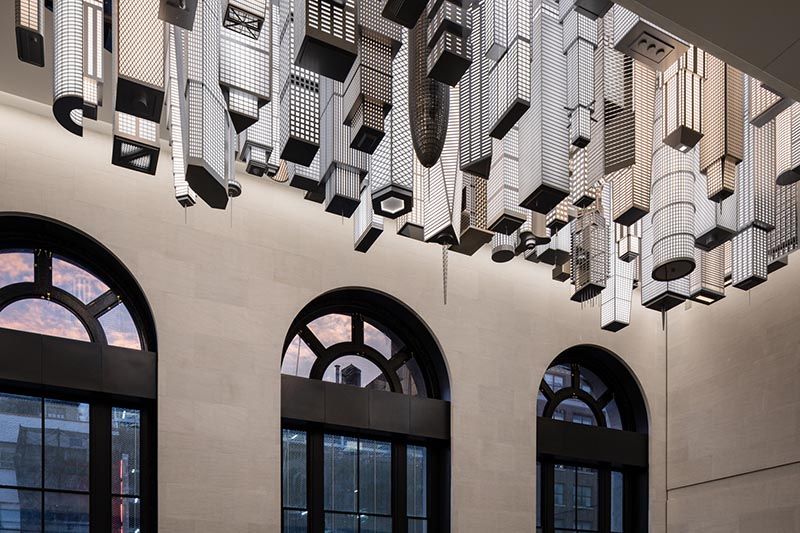
As part of Elmgreen & Dragset‘s work The Hive, over 30,000 pounds of futuristic skyscrapers hang upside down by the West 31st Street entry. The 91 real and fictional buildings, which are nine-foot-tall models, contain windows that glow with 72,000 tiny LED lights. Six of the aluminum buildings can change colors, and there is a mirrored base that allows commuters to feel projected into the miniature city.
Dragset told The New York Times that the installation was named “The Hive” to reflect how the diversity and richness of cities can function because people accept certain rules for coexisting. The artists shipped the work to New York from Germany, and the buildings weigh more than 30,000 pounds. Michael Elmgreen and Ingar Dragset, the artistic duo that works and lives in Berlin, investigate social, cultural, and political structures through their installations.
Andrew Leicester’s “Ghost” series
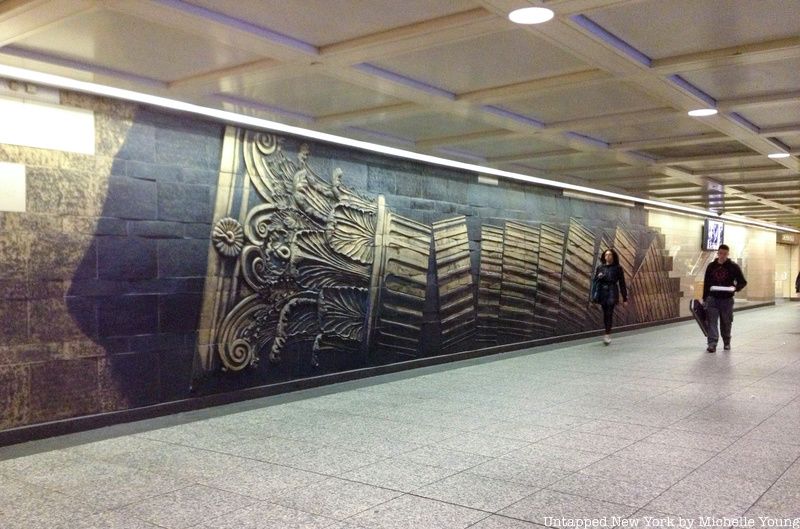
Andrew Leicester’s “Ghost Series,” installed throughout the Long Island Rail Road section of Penn Station, consists of five bas-relief terra cotta murals that point to the 1910 Pennsylvania Station building. The murals symbolically reveal the old building hidden behind new walls. A 500-square-foot mural called “Day and Night” (currently covered due to ongoing construction) reimagines Adolph Weinman’s namesake sculpture that depicts two women flanking a gigantic clock. On the clock’s face, Leicester added the date when the original building was demolished, October 28, 1963.
“Mercury Man” is another mural in the series that reproduces another sculptural figure. Leicester also included a porcelain-on-steel rendering of blueprints for the demolished building. The artist who was born in England and now lives in Minneapolis also creates art that forms links between its specific location and the host community, often as a result of extensive research.
Remnants of the Original Penn Station
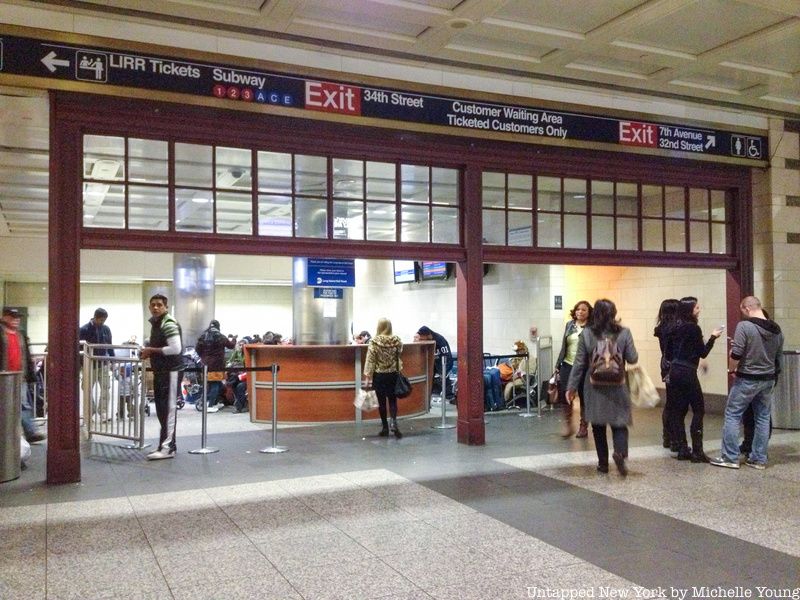
A cast-iron partition in the Long Island Railroad waiting room is one of the several remnants of the original Penn Station that still exist within the current station. The entryway survived since it was walled off during the demolition and forgotten for 30 years.
Throughout the station are also original brass and wrought iron staircases that simply stayed put during renovations. Some original glass brick flooring, that initially allowed natural light to reach lower levels, is still there, as well as the original coal-fired power plant of the station.
Original IRT sign
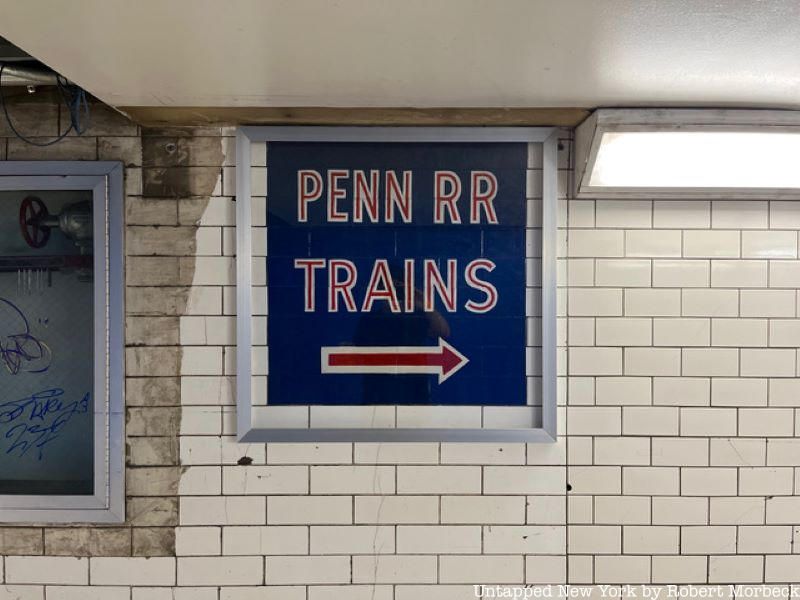
Long before the MTA existed, the Interborough Rapid Transit Subway (IRT) supported New Yorkers’ public transportation needs. The first IRT line opened almost exactly 117 years ago on October 27, 1904. Many of the IRT‘s historic signs, photos, and other physical remains have been lost. However, an IRT sign was recently restored and put under protective glass in Penn Station, built originally for an express station on the IRT Broadway–Seventh Avenue Line. The sign simply reads “PENN RR TRAINS” in red on a dark blue background with a red arrow.
The IRT Broadway–Seventh Avenue Line was built in conjunction with the Lexington Avenue Line, which made it easier to travel between Broadway and Park Avenue thanks to the 42nd Street Shuttle. According to our Chief Experience Officer, Justin Rivers, who leads tours of the Remnants of Penn Station, the IRT sign was originally an Interborough Rapid Transit Sign, most likely from the 1920s or 1930s. It is the last of the hand-painted signs in Penn Station itself—there is one faded IRT Trains sign at the top of the stairs to the southbound 1 train, but technically, that is not in Penn Station.
Diana al-Hadid’s The Arches of Old Penn Station and The Arc of Gradiva
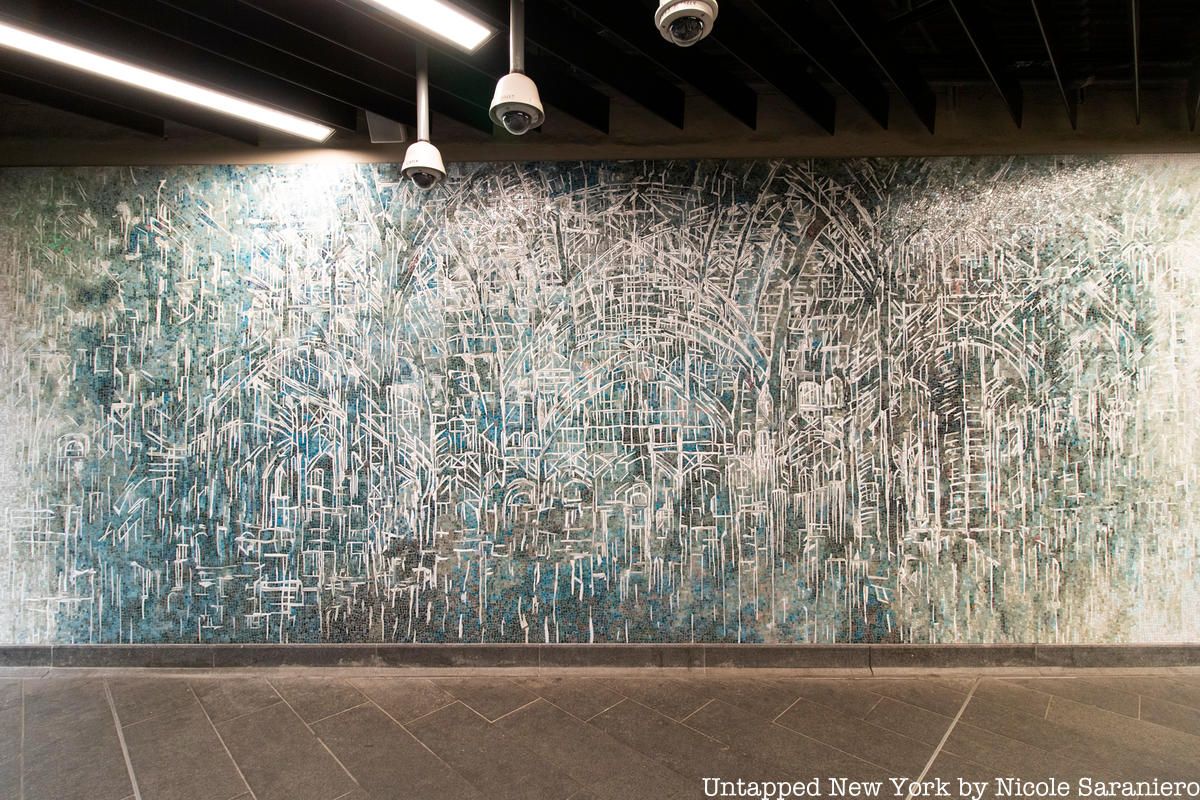
The redesigned entrance of the 34th Street-Penn Station subway station opened in late 2019 with little fanfare. The creation of the work The Arches of Old Penn Station by Diana al-Hadid accompanied the redesign. The work, featuring blues, teals, pearls, and golden browns, alludes to a resurrected glass atrium in the lost Pennsylvania Station. This atrium was darkened with soot and painted over during World War II and was an example of what many cited as the building’s irreversible decline. The pearly white mosaic tiles recreate the steel and glass structure, and the work fades into all-white tiles on both sides.
Nearby, al-Hadid’s The Arc of Gradiva takes its namesake subject from a 20th-century novel by German author Wilhelm Jensen, which is itself a reference to a Roman bas-relief. Gradiva, who is a mythological character who wanders the ruins of Pompeii, is used to suggest a “ghostly apparition” from the past following the footsteps of people who traverse the station. The pieces were commissioned by MTA Arts & Design, and al-Hadid previously had an exhibition inside Madison Square Park called Delirious Matter.
In 2023, another piece by Al-Hadid debuted at a newly opened fully accessible street entrance and fare control area at 7th Avenue and 33rd Street. Titled The Time Telling, the mural artistically recreates the clock that once hung at the entrance to New York City’s lost Penn Station.
New Jersey Transit “History Preserved” mosaics
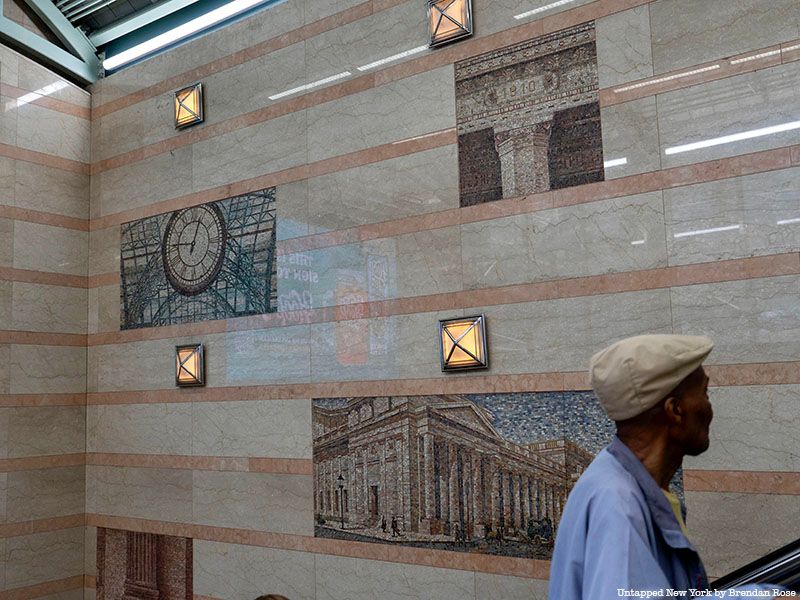
New Jersey Transit commissioned 11 natural stone mosaic panels created by Yakov Hanansen for its new entrance to Penn Station at 7th Avenue in 2007. The mosaics, which are in the series “History Preserved,” include one depicting the entire old Penn Station and many with smaller details. These include details of columns, the street, arches, and the old building’s interior.
Hanansen and his wife Angele are both well-known mosaic artists who founded Unicorn Art Studio in 1995. He has works displayed at 529 Fifth Avenue in the main lobby and at the Jewish Community Center in Forest Hills.
An Original Penn Station Eagle
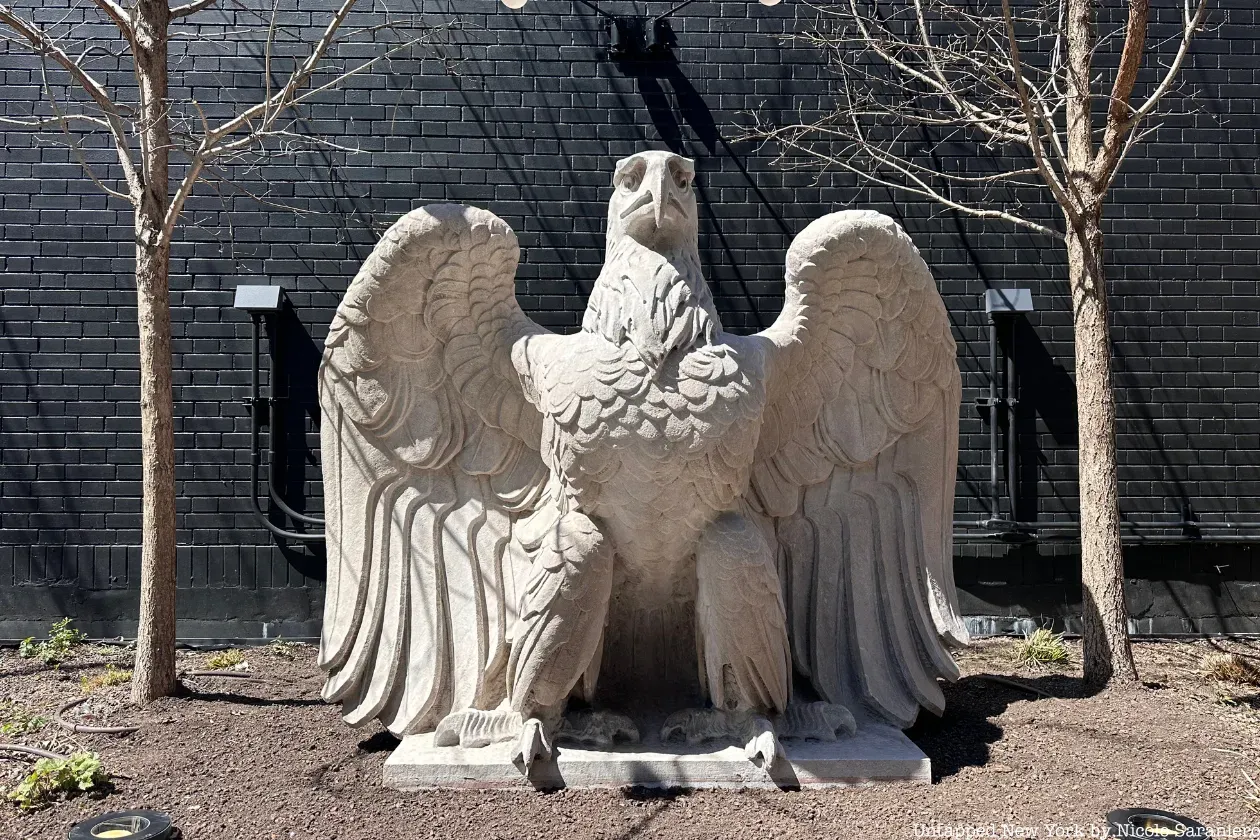
When the original Pennsylvania Station was demolished in 1963, most of the 22 eagles of the station facade were scattered around the country. All of the eagles were designed by German-born sculptor Adolph Weinman, who was hired by McKim, Mead & White for the station’s sculptural decorations. One of those original eagles has finally come back to the Penn District and can now be found at PENN 1’s West Plaza. Cleaned and restored by Urban Art Projects, the eagle weighs 7,500 pounds!
Next, check out how one Penn Station eagle surfaced at Valley Forge Military Academy!
