The 19-unit Art-Deco complex that is Rockefeller Center is one of New York’s most popular tourist destinations. Every year, the center hosts the largest Christmas tree in the country, films a handful of national television’s most popular primetime talk shows, and is the site of a handful of popular television shows, including Saturday Night Live and 30 Rock.
The center, completed in 1939 and named for John D. Rockefeller Jr., the son of the Standard Oil Founder John D. Rockefeller, exemplifies the crossroads of entertainment, corporate America, retail, and tourism, that is the Big Apple.
1. Two holdout buildings almost stopped the construction of Rockefeller Center
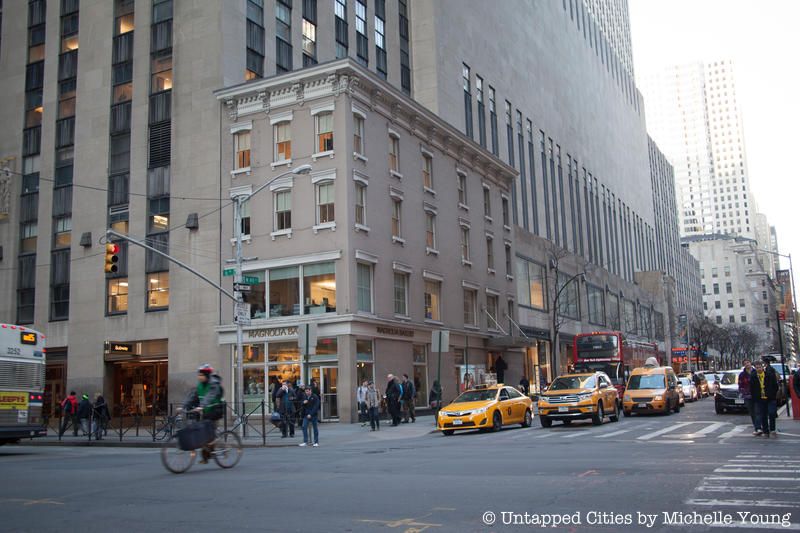
A Magnolia Bakery currently resides in one of the holdout buildings around Rockefeller Center.
In the midst of the Great Depression, most landlords were pleased or at least amenable to Rockefeller’s offers to buy the land, except for the owners of the two townhouses on either end of 30 Rock. Forced to build above and around the two townhouses, the 70-story 30 Rockefeller Plaza building remains sandwiched between two three-and-four story structures.
A Magnolia Bakery currently occupies the former Hurley’s, a bar and saloon that opened in the 1890s and later became a famed watering hole for the media industry. The three Hurley brothers were hardly fazed by Rockefeller, asking for an absurdly high sum to underscore their refusal to leave. As one Hurley brother said, “I’ve seen sonofabitchin’ Rockefellers come and sonofabitchin’ Rockefellers go and no sonofabitchin’ Rockefeller’s gonna tear down my bar.” Less theatrical but equally firm in his refusal to leave, John Maxwell simply refused to negotiate at all, whether in seriousness or not. As such, his stout building still stands today.
2. The first botanical gardens in the United States were in Rockefeller Center
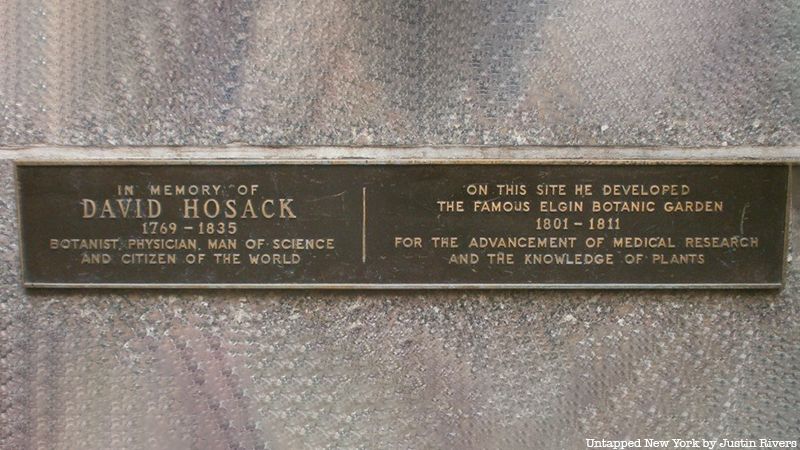
Today, a plague honors Dr. David Hosack and his botanical garden in Rockefeller Plaza.
Before the site of Rockefeller Center hosted thousands of tourists and some of New York City’s most popular television stars, it was the site of the first botanical garden in the United States. Doctor David Hosack, a well-known doctor known to have aided Alexander Hamilton and Aaron Burr, also had a passion for botany. He channeled this passion into the creation of this garden, which was characterized by a wide variety of medicinal, indigenous, and exotic plants.
In addition to the plants, Hosack’s gardens, known as the Elgin Botanic Garden, included a conservatory and protective wall. These gardens were located more than three miles above city limits but were open to the public from 1801 to 1811. Eventually, Hosack sold the gardens to New York State who allowed them to undergo decay. Today, the Channel Gardens provide a reincarnation of Hosack’s beloved botanical garden.
Art Deco Icons of NYC Tour
Fridays at 4 pm and Sundays at 10 am: Explore landmarks like the Chrysler Building, Rockefeller Center, and more from a new perspective.
3. The center has a series of secret rooftop gardens
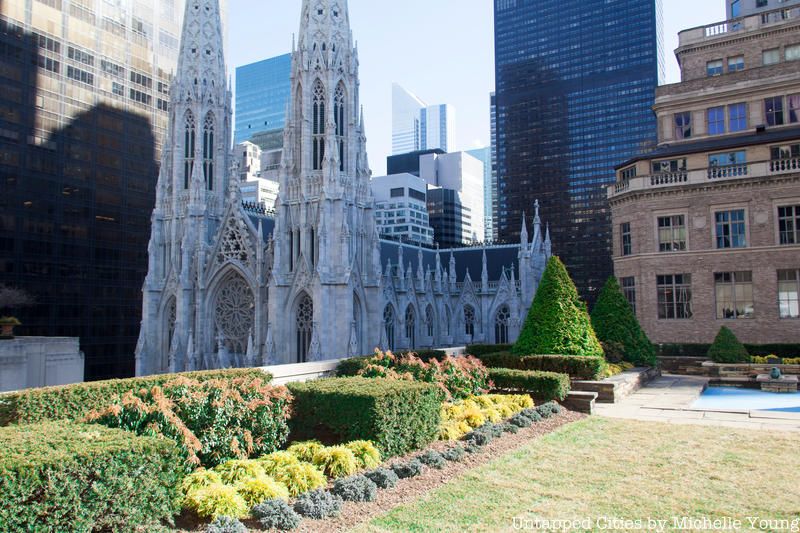
The view of St. Patrick’s Cathedral from Rockefeller Center’s secret rooftop garden.
Rockefeller Center’s rooftop garden is so exclusive that tour guides are not allowed to take tenants to enjoy the view of St. Patrick’s Cathedral and more from the cultural center’s perfectly manicured rooftop. Though the original garden is rumored to have once hosted koi fish swimming in ponds, Rockefeller Center recently opened a new rooftop garden called Radio Park. Both parks now exist, with one on top of Radio City Music Hall and another located at 620 Loft and Gallery, part of 620 5th Avenue.
Accessible only to Rockefeller Center employees, tenants, and their guests, Radio Park stretches half an acre and boasts views of the city stretching above Rockefeller Plaza. The creators of the garden hope that it serves as a space where employees of different companies based in Rockefeller Center can meet to socialize, destress, and enjoy a variety of “garden rooms,” which host different natural environments.
4. Radio City Music Hall has a hidden apartment
Photo Courtesy of MSG Entertainment
Aside from hosting the Christmas Spectacular, featuring the Rockefeller Center Rockettes, since 1933, Radio City Music Hall was originally a high-class entertainment venue, conceived to put Rockefeller Center on the map. Nestled within the “showplace of the nation,” a hidden apartment within the venue is now a spot used to entertain A-List guests.
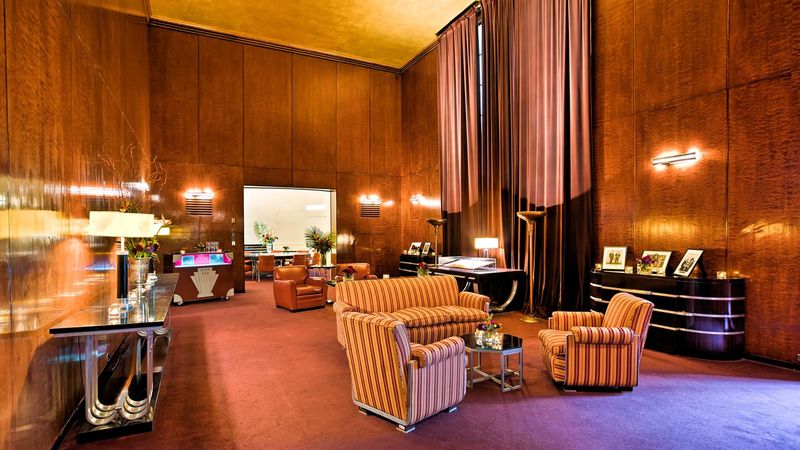
The architect of Radio City Music Hall, Edward Durrell Stone, and its interior designer Donald Deskey, originally built the apartment inside Radio City for famous entertainer Samuel “Roxy” Rothafel. With the same Art Deco design, the apartment was the perfect place to entertain the greats of Hollywood’s golden era, such as Alfred Hitchcock, Samuel Goldwyn, and Olivia de Havilland. As reported by Atlas Obscura, the “20 foot high ceilings covered in gold leaf, and walls decorated floor to ceiling with plush drapes.” It is reportedly still in pristine condition.
5. 30 Rock is the site of the most famous American vintage skyscraper photo
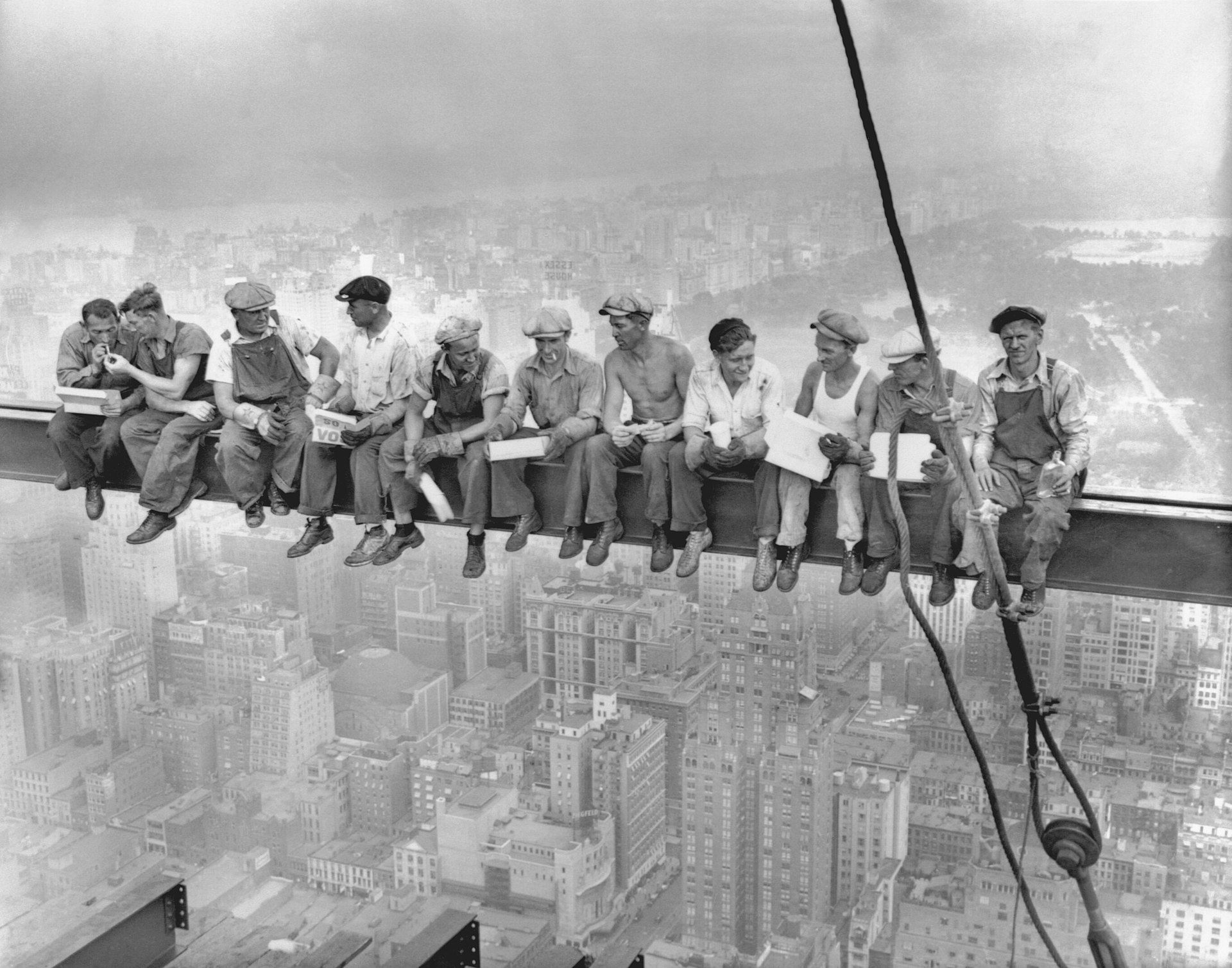
The photo “Lunch Atop a Skyscraper.” Courtesy of Wikimedia Commons and photo by Charles Clyde Ebbets.
This photograph has been copied and parodied hundreds of times throughout history, so often that it stands among the ranks of Salvadore Dali’s ‘Persistence of Memory’ and the stern-faced, pitchfork-wielding couple of ‘American Gothic.’ This photograph, ‘Lunch Atop a Skyscraper,’ was taken in 1932 on the 69th floor of the RCA building, now the GE Building, otherwise known as 30 Rock.
Though it is believed, through archival records, that the men pictured were real construction workers, the photo was in fact staged by Rockefeller Center and published in The New York Herald Tribune to promote the new skyscraper. Nevertheless, the photo has lived on as a testament to the sweat sacrificed for New York City’s skyline.
6. It was the seat of British Intelligence’s American operations during World War II
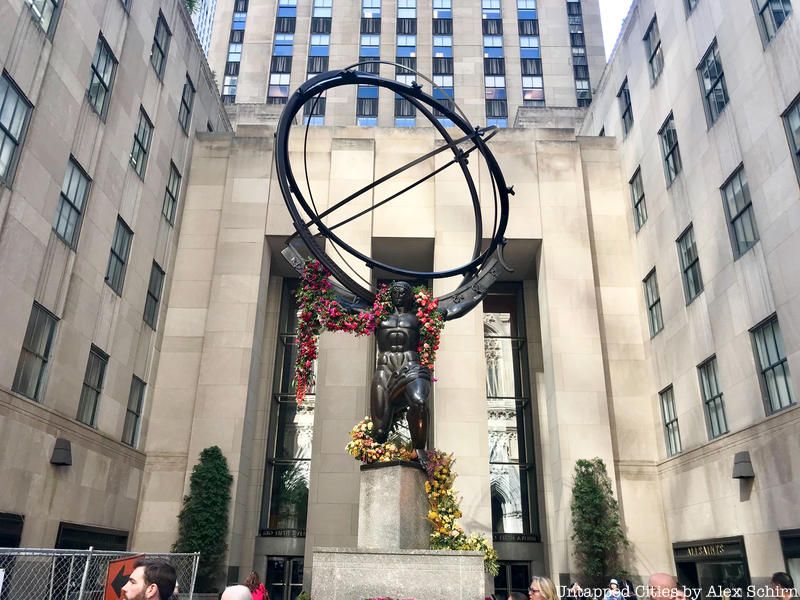
The stars of Saturday Night Live now walk past Rockefeller Center’s statue, Atlas.
Preceding World War II, Rockefeller Center’s International Building North was fated to become occupied by German companies with plans to rename the building the Deutsches Haus. However, as German aggression increased under the rule of Adolf Hitler, John D. Rockefeller Jr. would not allow that ownership to occur. As such, British Intelligence set up their base of operations in that building throughout World War II.
Beginning with Hitler’s occupation of Poland, the British intelligence center handled top-secret information in New York City years before the United States entered the war. The building’s room 3603 was additionally used as the headquarters of Allied Intelligence and functioned as the office of Allen Welsh Dulles, who would become the civilian director of the yet-to-be-formed Central Intelligence Agency.
7. The GE Building’s original, scrapped lobby mural contained a portrait of Vladimir Lenin
Read the Full Story
This article is available to Supporter tier members and higher. Join for just $5/month to unlock 12,000+ stories about New York City.