
New Hidden Histories Partnership with Apple Podcasts
Apple Podcasts's new Hidden Histories guides focus on "surfacing little known histories tied to those places."
Apple Podcasts's new Hidden Histories guides focus on "surfacing little known histories tied to those places."

Archtober, NYC’s architecture and design month and an annual festival of architecture activities, programs and exhibitions, starts soon!
Explore a different building in NYC nearly every day of October on special architect-led tours!

At a nondescript building on Liberty Street, Tesla invented a ground breaking machine. But does anyone remember?

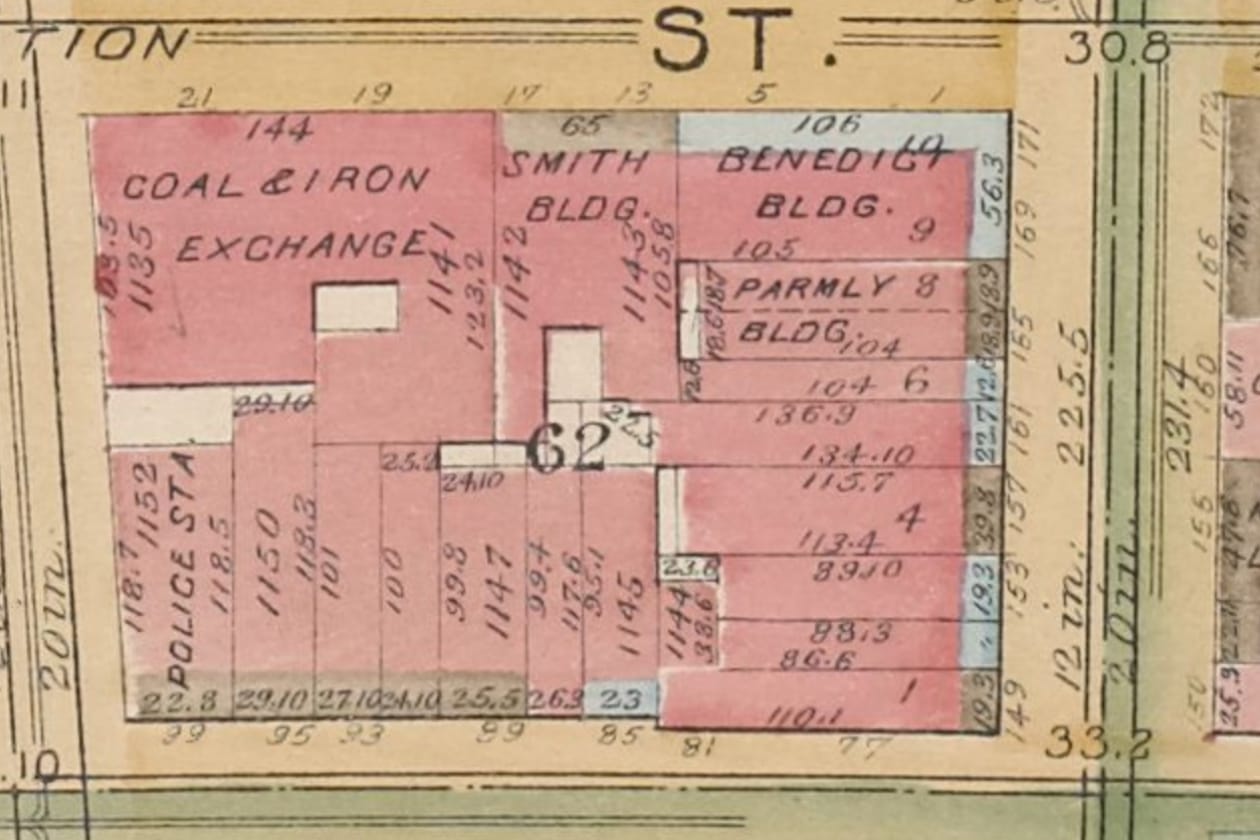
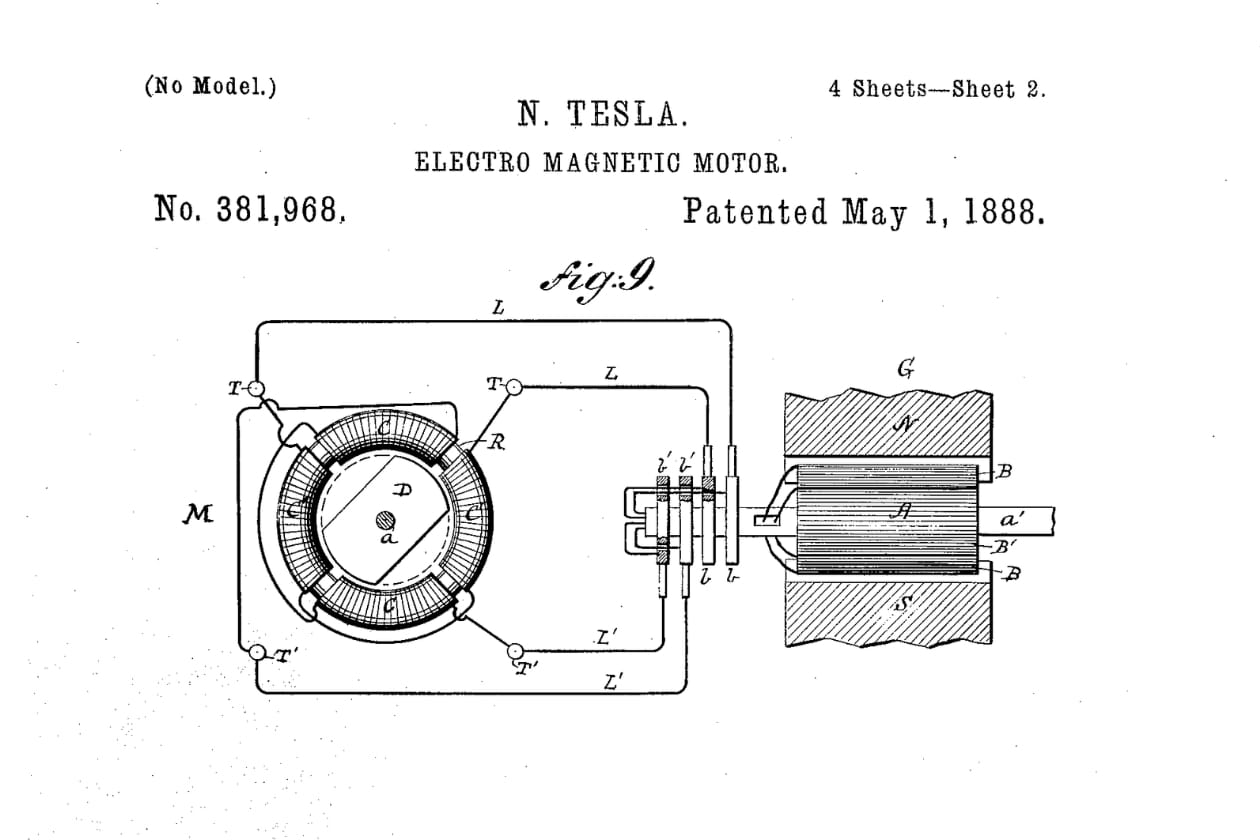
One of the most important inventions of the electrical age was invented at 89 Liberty Street in Lower Manhattan, but there is no marker of this site's significance. In the 1880s, Nikola Tesla's first laboratory occupied the second floor of a four-story commercial building at the site. It was here that the great inventor built and patented the first alternating current motor, an innovation that would enable the construction of the modern electric grid.
With the original building now long gone, Zuccotti Park is the perfect place to mark this achievement. The park is directly across the street from One Liberty Plaza, and an invention of this magnitude deserves to be recognized in a prominent public place.
But why was Tesla's invention so important? We all have some familiarity with the “War of the Currents,” i.e., the competition over which was better: alternating or direct current. Most people, however, do not know what Nikola Tesla accomplished to turn the tide in favor of alternating instead of direct current.
In 1878, fresh from inventing the incandescent light bulb, Thomas Edison announced to the press that he would build the first commercial electric distribution system in New York City. Edison planned to use direct current because, among other reasons, it was the scientific consensus at the time that only direct current was feasible. The construction of an alternating current motor was deemed impossible.
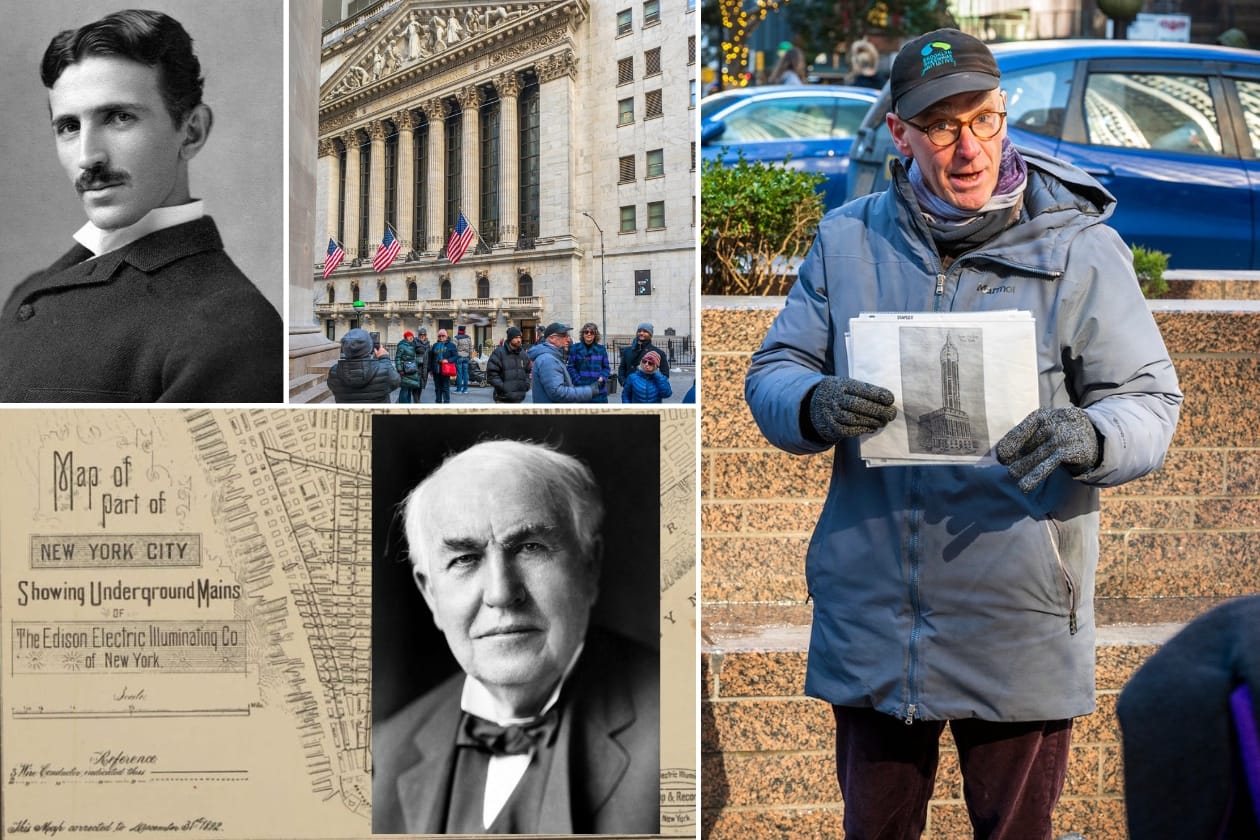
Multiple Dates & Times: Explore the origins of the electric age in Lower Manhattan as you untangle the wires of a notorious feud between Tesla and Edison.
⭐ 50% off for Insider tier members or higher!
While Edison initially built his system for lighting, all knew that electric motors would become even more important. Why build an electric system based on alternating current if it could not supply motors?
That same year, 1878, Nikola Tesla was in an electric engineering class in Graz, Austria. His professor explained the scientific consensus that an alternating current motor was a physical impossibility. Tesla responded by declaring that he would build such a motor. Even though the professor ridiculed him in front of the class, Tesla never gave up on his goal.
On June 6, 1884, Nikola Tesla walked off a boat in New York City with a letter of introduction to work for Edison. He had previously worked for an Edison affiliated company in Paris. Edison, now known as the "Wizard of Menlo Park," was world famous, and his electric company had successfully started up the world’s first commercial electric distribution grid on September 4, 1882, in lower Manhattan.
Tesla, eleven years younger than Edison, was just getting started. In his autobiography, My Inventions, Tesla writes that he impressed Edison from the start and that, because being Serbian was unusual at that time in New York City, Edison referred to him as “my Parisian.” While Edison’s letters from that time make no reference to Tesla, there is one document showing that Tesla was a highly paid Edison employee. While Edison must have recognized Tesla’s talent, Tesla admits in his autobiography that he chickened out and never asked to collaborate with him on developing an alternating current motor.
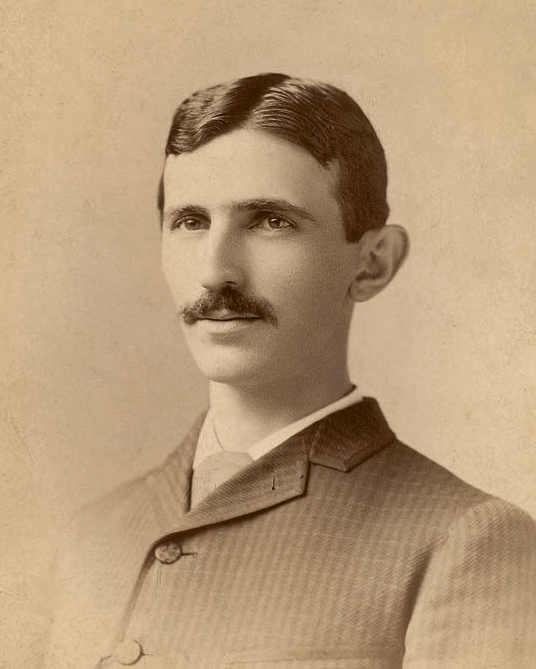
After a dispute over pay, Tesla left Edison to strike out on his own. He failed miserably. He fell in with Wall Street swindlers who left him penniless. In desperation for money to survive, Tesla became a ditch digger for the Western Union company. There he convinced the foreman of his crew that he was an electric genius. The foreman took him to see two Western Union executives, Alfred Brown and Charles Peck, who decided to finance him.
Brown and Peck rented a room for Tesla on the second floor of 89 Liberty Street. They chose that building because there was a printing press on the first floor and at night Tesla would be able to use the steam that ran the printing press to work on his inventions.
While at 89 Liberty Street, Tesla first had to convince Brown and Peck that they should finance his project to develop an alternating current motor. They were skeptical of alternating current and were more interested in their own scheme to use differential ocean temperatures to create steam to run electric generators. It is notable that even then there were investors dreaming of a way to make electricity from renewable sources.
Tesla convinced them by copying a Christopher Columbus legend. According to this legend, Columbus overcame his critics in the Spanish court by challenging them to balance an egg on one end. After they were unable to do so, Columbus made the egg stand upright by lightly cracking it on one end. Tesla said he did a form of this by copper plating an egg and then making it both stand on its edge and spin on top of a table by placing a primitive form of his alternating current motor under the table.
Peck and Brown were duly impressed and agreed to allow Tesla to work on this project. Tesla both perfected his model and developed his patents for this motor while working at 89 Liberty Street. He also wrote six other patents on how to operate an alternating current electric system.
In 2018, the Institute of Electrical and Electronics Engineers declared this motor was “the most significant invention of the electrical age.” But Tesla was pure inventor and no businessperson. Peck, however, convinced Tesla to give a lecture and demonstration about his motor at Columbia University on May 16, 1888. That is how George Westinghouse learned of the invention.
Westinghouse was interested in developing an alternating current electric system to compete with Edison’s system but knew he needed a working alternating current motor to develop such a system.
Westinghouse’s chief technical personnel visited Tesla’s office at 89 Liberty Street several times during June and July 1888. They became convinced that Tesla had developed a working alternating current motor even though one Westinghouse employee told Westinghouse that he could not understand Tesla’s explanation of how it worked. Westinghouse bought the patent rights in July 1888 and hired Tesla to work for him. The rest is history.
Westinghouse won the “war of the currents” because an alternating current transmission system is more efficient than direct current, and there was now a working alternating current motor.
The Singer Company demolished the lab building at 89 Liberty Street to make way for its famous skyscraper, the tallest building in the world from 1908 to 1909. The U.S. Steel Corporation in turn destroyed the Singer Building in the late 1960s to build its headquarters, which is now One Liberty Plaza.
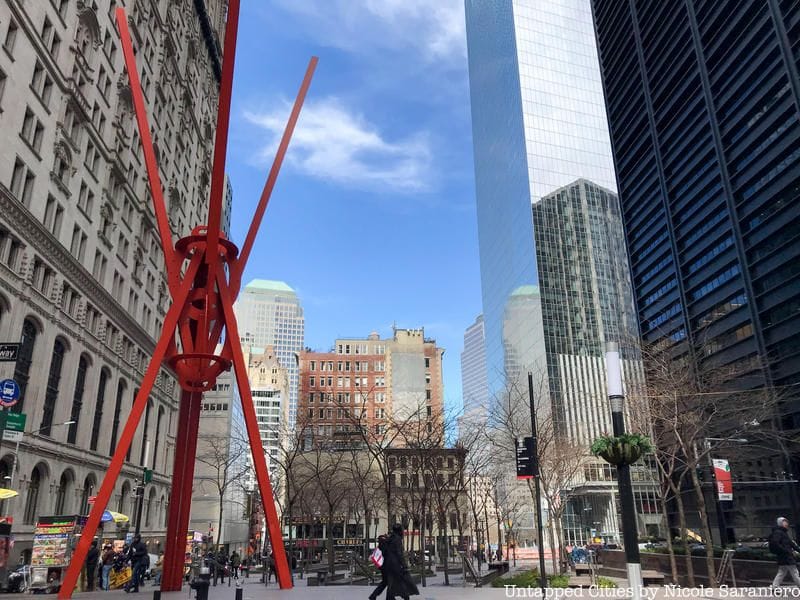
Zuccotti Park, a privately-owned-public-space (POPS) located on the opposite side of Liberty Street was created in 1968. Most famous for serving as the base of the Occupy Wall Street protests in 2011, the park offers a bustling public space where a marker to Tesla's achievements could easily be discovered by passersby, steps away from the forgotten site where his breakthrough invention was made.
There is a Nikola Tesla way at 40th Street and 6th Avenue, near where he lived out his last years at the New Yorker Hotel (at 34th Street and 8th Avenue). He also spent much of his time in Bryant Park with the pigeons there. But that sign does not commemorate the most world changing invention of one of the world’s greatest scientific geniuses.
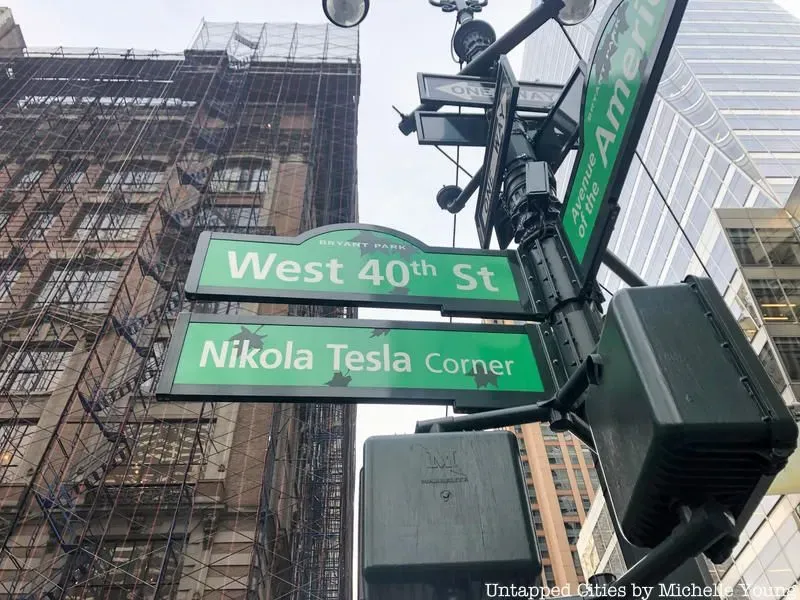
A plaque in Zuccotti Park would commemorate the early days of Tesla's classic immigrant story, the days when he was a striver who solved the Rubik’s Cube of how to build an alternating current electric system—a feat that the greatest minds of the time said was impossible—and proved that he could compete with Edison’s direct current system.
If you would like to help support a campaign to have a plaque installed please get in touch here and join the author, Richard Miller, an energy professional, on our next Tesla, Edison, and NYC's First Electric Grid Tour!
Subscribe to our free newsletters
Free Newsletters
Get the best stories and things to do sent straight to your inbox.

